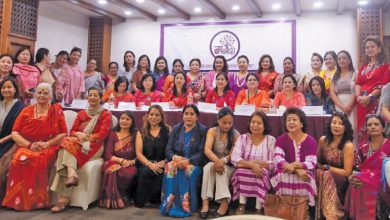
Photo: Gokarna Dayal Women dressed in traditional attire during the Gaura festival in Naugau, Dilasaini Rural Municipality-3, Baitadi.
By Gokarna Dayal,Baitadi, Sept. 10: The historical and cultural festival of Gaura in Far-Western Nepal is still celebrated, its indigenous character has gradually begun to decline.
In particular, women have started abandoning the traditional clothing and ornaments traditionally worn during the Gaura festival.
Gaura is celebrated with devotion and worship of Shiva and Parvati. In the past, women dressed in traditional attire would gather at Gaura grounds and perform Deuda dances.
However, due to modernisation and the influence of western fashion, the younger generation has gradually lost interest in traditional clothes and ornaments.
According to Keshav Bhatta, who travelled from Dhangadhi to his ancestral home in Dilasaini, Baitadi, to celebrate Gaura, the younger generation has increasingly adopted modern styles, causing the tradition of wearing traditional clothes and ornaments to disappear.
Bhatta said that these days, only some older women in the villages can be seen wearing traditional ornaments and clothing, while the younger generation shows little interest in them.
Traditional ornaments such as silver bangles worn on the hands, silver waist ornaments, muga and chawanni necklaces, silver anklets, nose rings and earrings many of which carry historical and cultural significance are now rarely seen.
The traditional gunyucholi once worn by women of earlier generations has largely been replaced by modern saris and kurta-suruwals.
Traditional games also at risk
It is not only traditional clothing and ornaments that are at risk. Indigenous games and dances performed during Gaura, including Deuda, Dhumari, Dhukso, Chaughan and Triphi, are also gradually disappearing, said 85-year-old local senior citizen Bir Bahadur Chanda.
Chanda expressed concern, saying, “These days, I cannot find women wearing the traditional 22-strand ghagara (guniya). Modern clothes are seen everywhere. No one seems to be taking the initiative to preserve traditional clothing and ornaments.”
According to him, if schools organise cultural programmes and make the use of traditional clothing compulsory, it could help preserve this historical heritage and introduce the younger generation to it.
Local elders say that if the government and concerned agencies do not take concrete steps in time to preserve indigenous culture, clothing, games and ornaments, there is a growing risk that the historical identity of Far-Western Nepal will eventually be confined to history books.
The Rising Nepal