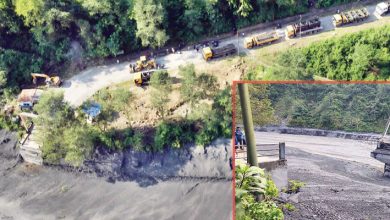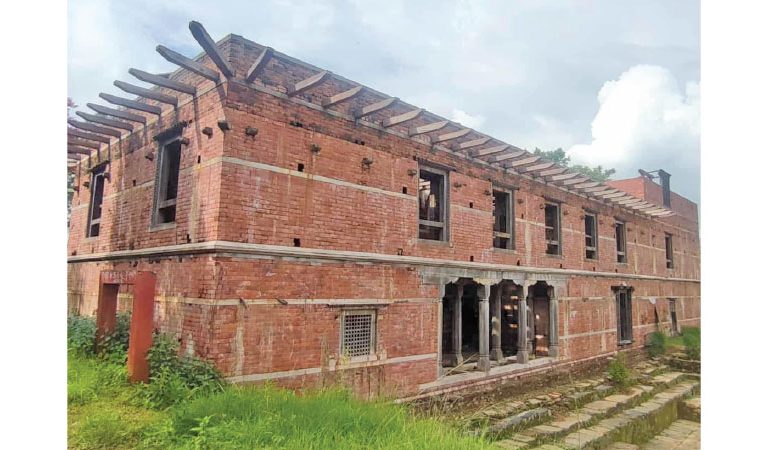
Photo: Nabin Raj Kuinkel Lamjung Durbar, where reconstruction work has been stalled.
By Nabin Raj Kuinkel, Lamjung, May. 1: Reconstruction of the historic Lamjung Durbar has remained stalled for a long period, raising concerns among locals.
The 16th-century palace, located at Gaunshahar in Besishahar Municipality-3, has seen its rebuilding work halted for the past 15 months. Construction has not progressed since mid-January 2025, despite an initial target to complete the project within two years.
Locals said that the project, which began about five years ago under the Department of Archaeology, remains unfinished even near completion. “We were told it would be completed in two years, but the work has been stalled for a long time,” said local resident Suresh Shrestha.
Rajendra Bohora, chair of the Gaunshahar Kalika Temple Conservation and Management Committee, said repeated requests to the Department of Archaeology have gone unheard. The department has cited a lack of sufficient budget for the delay.
Ward Chairperson Chitra Bahadur Danai also blamed inadequate budget allocation for the stalled reconstruction of the historic site.
Engineer Gobinda Adhikari of the Department of Archaeology said delays were caused by various factors, including procedural issues and tender processes during the current fiscal year. He said a contractor has now been selected and work is expected to resume soon.
According to him, Avan Company, Kathmandu, has secured the contract worth around Rs. 4.2 million. Several works are still pending, including wall construction, roofing, wood placement, installation of the pinnacle, plastering, doors and windows, painting, and flooring.
The department said this year’s budget will not be sufficient to complete the entire project. It will mainly cover upper wall construction, roofing preparation, and inspection of timber structures.
The reconstruction began in fiscal year 2019/20 with a budget of Rs. 13.3 million, while only Rs. 5 million was allocated in the following fiscal year. Different contractors have handled the project in phases.
The palace is being rebuilt in its original style as a three-storey structure with an attic, while the Kalika Temple will follow a traditional pagoda design. Construction materials such as bricks, timber and lime mortar have been sourced from Bhaktapur.
According to the management committee, the palace complex covers 16 ropani of land.
Lamjung is regarded as the origin of the Shah dynasty, and the palace is a key part of that heritage. Historical records state that Kalu Shah was installed as the first king of Lamjung in 1540 BS, followed later by Yashobrahma Shah, who ascended the throne in 1550 BS.
TRN Online