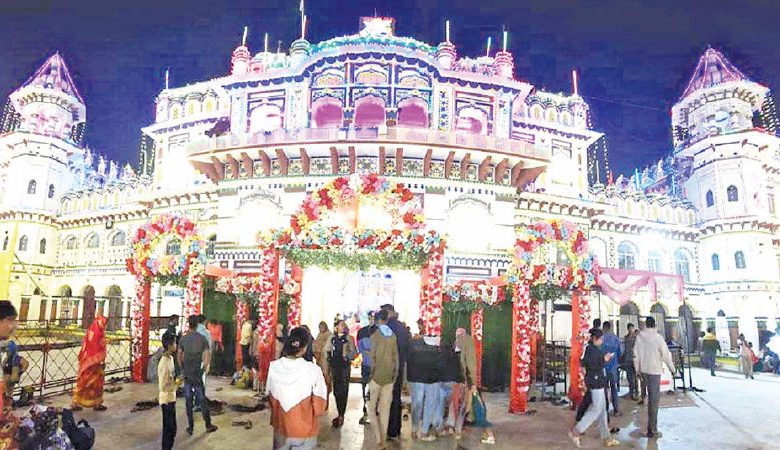
By Ajay Sah,Janakpurdham, may.1: Janakpurdham has become a symbol of vibrant cultural life. This ancient and historic city, rich in religious, historical, and cultural significance, has in recent years been emerging as a major destination for religious tourism.
Janakpurdham, which is also the capital of Madhes Province, is known as the capital of the ancient Mithila kingdom of King Janak.
Major attractions of Janakpurdham include the Janaki Temple, Ram Temple, Lakshman Temple, and the Sankatmochan Hanuman Temple near the Rangabhoomi area.
Likewise, religious and historical sites such as Rasik Niwas, Agnikunda Kuti, Biharkund, Ranipati, Piprakuti, and Hanumat Durbar have also been attracting tourists.
The presence of sacred ponds such as Gangasagar, Dhanushsagar, Ramsagar, Ratnasagar, Agnikunda, and Argaja further elevates the spiritual significance of Janakpur.
Religious festivals and events such as Vivah Panchami, Ram Nawami, Janaki Nawami, Chhath, Jhula, and Parikrama make tourism here even livelier. On such festivals and occasions, a huge influx of both domestic and international tourists is observed.
Religious scriptures such as the Valmiki Ramayana, Bhagavata Purana, and Vishnu Purana describe Janakpur as a sacred land, a place of penance, and a superior pilgrimage site.
In the Sreesitayan as well, Janakpurdham is described as ‘Sachchidananda Dham’. According to historical and mythological accounts, tourists have been visiting Janakpur since the Vedic period.
From Videha Madhav to sages such as Yajnavalkya Gargi, Maitreyi, and Ashtavakra, references are found in scriptures of their visits here and involvement in philosophical discourse and pursuit of knowledge.
Likewise, it is believed that the Janakpur area is also the birthplace of the 24th Tirthankara of Jainism, and there are references to Mahabir having spent some time here. Janakpur is also mentioned in Buddhist texts.
Around 643 AD, the Chinese traveller Xuanzang mentioned his visit to Janakpur in his travel accounts.
During Prithvi Narayan Shahs’s unification campaign, when King Jaya Prakash Malla of Kathmandu sought support from the British against Shah, the British entry into Nepal in 1767 via Kinloch is historically recorded to have occurred through Janakpur.
In the modern era, the arrival of foreign volunteers, researchers, and artists has also contributed to expanding Janakpur’s international recognition.
Areas around Janakpur such as Dhanushdham, Jaleshwornath Temple, and Girijasthan have further strengthened religious tourism.
According to cultural expert Dr. Ramdayal Rakesh, religious tourism is the oldest form of tourism in the world, and Janakpur holds ample potential in this regard.
Similarly, researcher Dr. Rajendra Bimal said that the monasteries, temples, and sculptures here are witnesses to historical rise and fall.
Tourism scholar H. Robinson notes that the fundamental elements of tourism — attractive environment, historical heritage, accessibility, and hospitality are present in Janakpur, making it suitable for planned development.
The period from September to December is considered favourable for visiting, as major festivals of Mithila fall during this time, making the stay more appealing for tourists.
In recent years, the flow of Indian and domestic tourists has been increasing throughout the year.
Hiralal Gautam, President of the Hotel and Tourism Entrepreneurs Federation, Madhes Province, said that tourism, currently centred around Kathmandu, Pokhara, Chitwan, can be expanded to develop Janakpur as a major destination.
Similarly, Professor Dr. Bhogendra Jha said that Janakpur can be branded as a wedding destination and developed into an international destination for newlywed couples.
Although the budget for the fiscal year 2081/82 included programmes to develop Janakpur as a marriage hub and Lumbini as a birthing hub, implementation in accordance with this plan still appears to be pending.
Thus, according to Hiralal Gautam, President of the Hotel and Tourism Entrepreneurs Federation, Madhes Province, there is sufficient basis to develop Janakpurdham into an international-level religious tourism centre through systematic planning, infrastructure development, and effective promotion, given its rich historical, religious, and cultural heritage.
The Rising Nepal