By Pramod Joshi, Kathmandu, Sept. 13″: Mother Nepal deserves a Gold Medal. Expect one,” is what Arika Gurung said while acclaiming her third consecutive Best Female Player of the Year title during the 23rd edition of the NSJF Pulsar Sports Award held on September 4.
Karateka Gurung referred to Nepal’s gold medal drought in the Asian Games.
The gold has been an elusive dream so far for Nepali athletes in the continental multi-sporting event.
From the first edition to the 19th edition held in Hangzhou, China in 2023, Nepali athletes reached closer to the gold medal thrice but only ending with silver medal.
During those 75-years, Nepal managed only three silver medals and 23 bronze medals.
Nepal started competing in the Asiad since the first edition held in 1951 in New Delhi, India. Apart from second and fourth edition held in 1954 and 1962, Nepali athletes have taken part in all other editions of the Asiad.
With a sight on elusive gold medal, 135 athletes from Nepal will be eying to make a history in the 20th Asian Games to be held in Aichi-Nagoya of Japan.
Asia’s biggest multi-sport event is all set to kick start from 19 September until 4 October, where more than 11,000 athletes and 6,000 officials from 45 countries and regions, the OCA Refugee Team will be competing for 1407 medals. The 2026 edition of the games will feature 43 sports and 71 disciplines, with 1407 medals in fray across 469 events.
This is the third time Japan is hosting the Asian Games, following Tokyo 1958 and Hiroshima 1994.
Uniting the continent under the official motto, “Imagine One Asia,” the event will be supported by 10,200 volunteers and covered by 5,300 accredited media representatives.
Nepal will be sending a total number of 211-member contingent to Japan. Competing in 21 sports disciplines, 57 female and 78 male players will be providing Nepal’s challenge in the multi-sport event. They will be accompanied by 29 coaches and 17 officials and two sports technicians.
Member Secretary of National Sports Council Ram Charitra Mehta will be leading the Nepali contingent as Chef de Mission.
Gold hope Arika
This time Nepal’s hope is pinned on Karateka Gurung. She made a history in 19th Asiad by winning a silver medal for Karate for the first time and overall, third for Nepal.
Nepal’s accomplished karateka has been recreating history not only by bagging silver medal in Asian Games, but also been proving her mettle in karate’s elite tournaments.
She had won two silver and one bronze medal in Karate One Premier League organized by World Karate Federation. She also has one gold medal in Karate1 Series and silver medal in Karate 1 Youth League under her belt. She also has one silver and one bronze in Asian Senior Championship.
After already clinching silver medal, the obvious target for Gurung is the gold medal.
To boost Gurung’s chances, Karate team have already left for Japan for their final and special training at the World Shitoriyo Karate’s headquarters in Tokyo, Japan, two weeks before the continental summer games start.
Struggle for medal
Achieving medals in the continental sporting fiesta has not been easy for Nepali athletes. It was only after 35 years Nepal was successful in winning the first Asiad medal.
Bidhan Lama of Taekwondo clinched Nepal its first medal at the 10th Asian Games held in Seoul, South Korea, in 1986. It is in the same edition, when Nepal not only bagged its first medal but also won eight medals, which became the largest medal haul of Nepal so far. Then, Nepal won four bronze medals in Taekwondo and four in boxing.
In 1990 Beijing Asiad, Nepal, however, managed one bronze medal in boxing. In 1994, in Hiroshima, Japan, Nepal collected two bronze medals, one in Taekwondo and another in Karate.
The 1998 edition became another historic moment for Nepal after Sabita Rajbhandari of Taekwondo brought Nepal its first silver medal. The silver was achieved after 50 years of Nepal’s participation in Asiad. Nepal also added two bronzes in Taekwondo and one bronze in Karate.
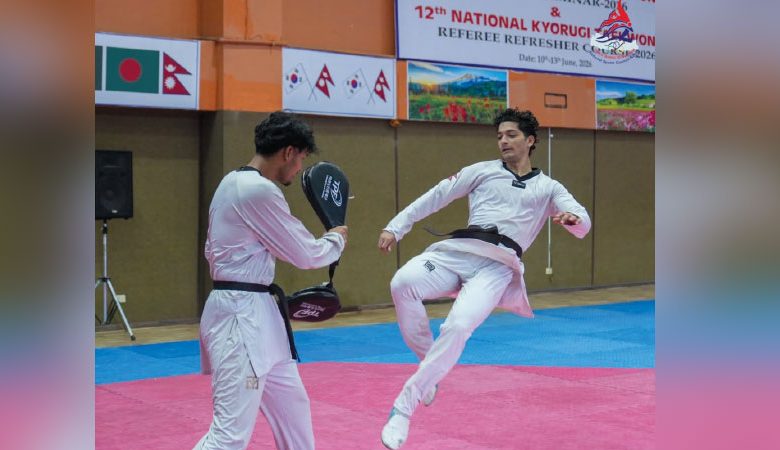
Taekwondo continued to bring medals for Nepal. At the 2002 Busan and 2006 Doha Asiad, three bronze medals each were achieved. Nepali Taekwondo legend Deepak Bista became the first and only player to bag Asian Games medals in a row. The record of Bista, winning medals in two consecutive editions of Asiad history, still stands.
Taekwondo has brought Nepal 14 out of 26 medals, that includes 1 silver and 13 bronze medals. However, since 2006 edition, Taekwondo has failed to win a single medal in Asiad.
It is not only Taekwondo, but Nepal’s overall performance also declined and struggled to bag a single medal. At the 2010, Nepal managed single bronze medal in Boxing, at 2014 edition Karate won a bronze in kata.
In 2018 edition held in Indonesia, paragliding team saved Nepal’s blushes with another historic silver medal- the second white medal of the nation and first ever medal in team event.
At the 19th Asian Games held in Hangzhou, China, Nepal bagged its third silver medal from Karateka Arika Gurung. The Hangzhou edition also became historic as women’s Kabaddi team clinched bronze in their very first Asiad appearance and second medal in team event for Nepal.
Playing for the second consecutive time, Karateka Gurung has the chance to equal the records of Taekwondo veteran Bista in Japan, winning medal in a row.
The real challenge, however, is to surpass 1986 feat, as the government has targeted a double-figure medal haul in the coming Asiad and run the special training right after the 19th Asian Games in 2023.
Mission 2026
The National Sports Council, the apex body of Nepali sports, conducted the special training under Mission 2026 title for three years.
It is the first time players were called to training camp three years prior to the Asian Games.
The ambition of the special training was to prepare Nepali athletes to win medals in double figure, including at least one gold in 2026 Asian Games and Para Asian Games, said Deepak Bista, head of National Team Preparation under the Council.
The main target is to provide a long‑term preparation for any formal international competition in which the nation participates. Initially, the special training included five sports but later it grew to 14 sports disciplines.
Karate, Boxing, Women’s Kabaddi, Women’s Volleyball, Taekwondo, Wrestling, Judo, Wushu, Golf, and Athletics were included in the training.
Also focusing on medals in Para Asian Games, players of Para Taekwondo, Para Swimming Para Athletics, Para Badminton and Para Powerlifting were included in the special training.
Former NSC Member Secretary, Tanka Lal Ghising, under whose directives the ambitious ‘Mission 2026” was launched, said the training was started to provide uninterrupted training opportunities to the national players.
But a lack of budget, political uncertainty, elections provided breaks during the three-year training.
Nevertheless, the national team players during the training were provided with psychological, physical, medial and nutritional counselling. Regular dietary allowances for athletes and coaches were managed.
To enhance the training level of the players, National High-Performance Centre (HPC) along with a National Sports Science Research Centre (NSSRC) to study the players’ physical capacity and structure was established during the period.
The national players from Mission 2026 camp benefitted from the HPC and NSSRC. The modern technologies installed at HPC and NSSRC helped the players identify their physical strengths and weaknesses and helped them overcome the weaknesses by providing training manuals.
The best of the best athletes from the Mission 2026 were selected for the Asiad and were put into the closed-door training camp one month before the games.
Besides, foreign training was also managed for the athletes. Along with Karate, players of Wushu, Taekwondo, Cycling, Swimming, Tennis, Table tennis, Wrestling, Canoeing, Golf, Skate board and Kabaddi are in overseas training camps. Cricket team is busy playing overseas tournament.
Before leaving for final training to Japan, Karate Kata Coach Monday Kaji Shrestha said the Mission 2026 training has been very helpful. It helped to select the best players for the Asiad. The selected players of all participating teams were put into closed camp under one roof for the first time by NSC.
Representing athletes in special training, Karateka Gurung said the Mission 2026 has changed the mindset of the players.
“Mission 2026 has allowed many athletes to train consistently and build the confidence that they can compete for medals. We believe the Aichi-Nagoya performance will be different for Nepal,” Gurung said.
“Focus on performance”
The government officially bade farewell to Nepali contingent on September 4. The players will be leaving for Aichi-Nagoya separately as per their match fixtures. The players training abroad will join Asiad directly.
As the pressure to deliver has been much from the special training to the players, Minister for Education and Sports Sasmit Pokharel urged them to focus on performance rather than fixating on the outcome. “”Deliver your best performance, gain valuable experience, and represent our flag with pride,” Pokharel said to the players.
Though the Asian Games will start officially on 19 September, Nepal will be kicking off its campaign from September 16 playing against host Japan in women’ s volleyball.
With just three days to go, it is time for the athletes to prove themselves in the Asian Games, as NSC Vice Chairman Bishal Shrestha puts in.
“Preparation has gone well. It is all about the execution on the mat. Expect the best performance from us. We will give our life,” said Karateka Gurung. Echoing Gurung, Wushu player Bijaya Sinjali said, “We are Gorkhalis and will give our absolute best for the nation.”
The Rising Nepal