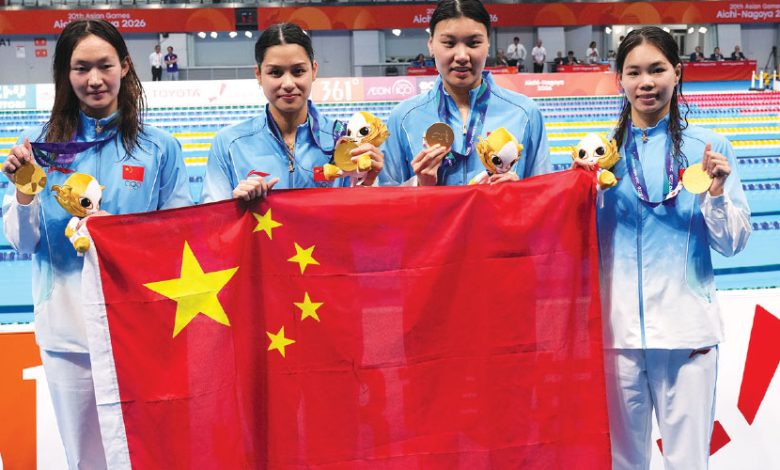
Nagoya, Sept. 28: They’re called the Asian Games. But more aptly, they should be called the “China Games,” another chapter in country’s four-decade domination of the continental, multisports championships.
Midway through the two-week event, China has won 107 gold medals with Japan on 31 in second place. The overall medal total is closer, but China still leads Japan 176 to 129 through Saturday’s results.
These Asian Games involve at least 11,000 athletes. That’s more than the Summer Olympics two years ago in Paris with about 10,700. And similar to the Olympics, the gap is very wide between the sporting haves, and the have-nots.
At the bottom of the medal table, four countries have only one bronze medal — Bangladesh, Brunei, Mongolia and Syria. And another half dozen countries have yet to win any medals
The global swim stars have been Chinese and Japanese
The six-day swimming competition dominated the first week, and here China piled up 30 golds. Freestyler Zhang Zhanshuo won seven golds and four came in every freestyle distance: the 200-meter, 400, 800 and 1,500. He also added gold in three relays.
Chinese 13-year-old Yu Zidi picked up three golds — 200 butterfly and the 200 and 400 individual medleys. Both swimmers will be forces at the world championships next year in Budapest, Hungary, and the Los Angeles Olympics the year after that.
Despite China’s power, the only world record went to Japan’s Shin Ohashi, who set the world mark in the 200 breaststroke (2 minutes, 4.83 seconds).
The Asian Games offer sports you won’t see elsewhere
Chances are you have never seen many of these sports. There’s kabaddi, which looks like a physical game of tag, sepaktakraw (foot volleyball), kurash (wrestling with roots in Uzbekistan), jiu jitsu, padel, soft tennis, teqball and wushu.
Of course, there are all the old Olympic standbys such as track and field, tennis, swimming, badminton, gymnastics, soccer, cycling, weightlifting, and so forth.
Esports are also in the Asian Games for the second time following the games in China three years ago. On Saturday 11-year-old Japanese schoolboy Yuki Kurihara won a gold medal.
Mixed martial arts is also being included for the first time with a long-shot eye at landing in the Olympics.
The version in the Asian Games can be described as “MMA Light,” fighting without the cage. Fighters wear gloves and shin pads, elbow blows are banned, and no knees or kicks to the head are allowed when a fighter is on the ground.(AP)
The Rising Nepal