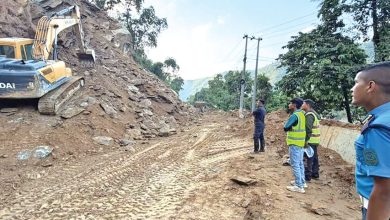
By Our Correspondent, Nawalpur, Aug. 14: The expansion of the Narayanghat–Butwal section of the East-West Highway nears completion with around 93 per cent of the work accomplished.
According to the project office, workers are currently carrying out road marking, planting trees and grass, constructing zebra crossings and installing speed limit signs along the 114-kilometre highway.
Traffic authorities have set different speed limits depending on the location. Vehicles are restricted to a maximum speed of 40 km/h through forested areas, including sections passing the buffer zone of Chitwan National Park, community forests and dense woodland. Traffic police regularly monitor vehicle speeds using radar guns to enforce the limits.
In built-up areas, the maximum speed limit has been set at 60 km/h, while vehicles are also restricted to 40 km/h in the Daunne section. On other stretches of the highway, motorists may travel at speeds of up to 80 km/h, depending on road conditions and traffic volume, said Traffic Police Inspector Kushal Bartaula, chief of the District Traffic Police Office.
He added that motorists passing through market areas and locations with pedestrian crossings along the highway are required to drive at a pace equivalent to approximately one kilometre per minute.
Explaining why lower speed limits apply in forest sections despite the relatively open road conditions, Inspector Bartaula said the restriction is intended to protect wildlife crossing the highway.
However, the Asian Highway-standard road has drawn criticism for lacking internationally recognised wildlife-crossing infrastructure. International practice recommends constructing underpasses and overpasses at key wildlife movement corridors in dense forests, but no such dedicated structures have been built along the 114-kilometre stretch.
Project Director Engineer Chunda Raj Dhakal of the Department of Roads’ Project Directorate (ADB) said the original contract did not include wildlife underpasses or overhead bridges. He said the Chinese contractor later declined a request to add the structures, arguing that doing so would result in financial losses.
Dhakal, however, said that 43 bridges along the highway had been modified to allow the movement of smaller animals.
He argued that greater priority should now be given to development rather than expanding wildlife infrastructure, claiming that conflicts with animals such as monkeys and wild boars had displaced settlements in some areas.
Despite the absence of dedicated wildlife crossings, Dhakal said an aerial rope bridge had been constructed in the Pitaunji forest of Gaindakot to facilitate the movement of monkeys. The upgraded highway features six lanes through major urban areas, four lanes across most sections and three lanes in the Daunne stretch.
The Rising Nepal