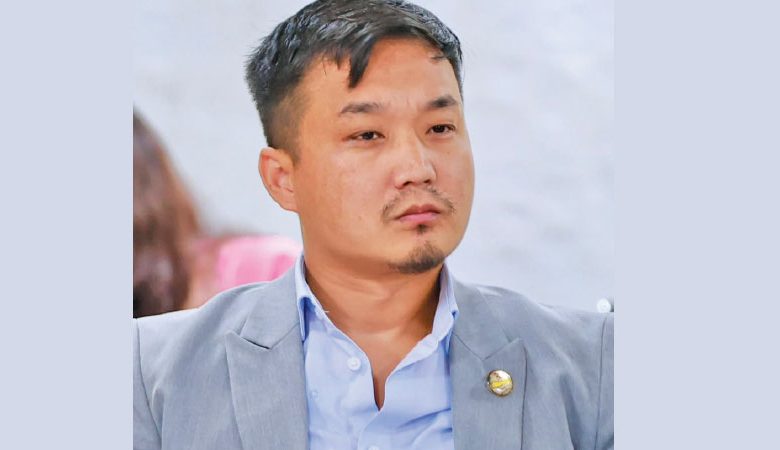
By A Staff Reporter, Kathmandu, Aug. 15: Minister for Home Affairs Sudan Gurung has expressed dissatisfaction over the manner in which lawmakers questioned Home Secretary Raj Kumar Shrestha and Inspector General of Police (IGP) Dan Bahadur Karki during a meeting of Parliament’s Public Accounts Committee (PAC), warning against tarnishing reputations based solely on allegations.
Addressing a meeting of the House of Representatives’ Law, Justice and Human Rights Committee on Friday, Minister Gurung said no one should be judged guilty merely on the basis of accusations or complaints.
“The way the IGP was treated has drawn the Home Minister’s serious attention,” Minister Gurung said. “We are not happy with it. We should not assume the role of judges simply on the basis of allegations and complaints.”
His remarks followed Wednesday’s PAC meeting, where lawmakers discussed complaints alleging irregularities in the procurement of uniforms and other supplies for the Nepal Police, Armed Police Force and Election Police.
During the meeting, ruling Rastriya Swatantra Party (RSP) lawmaker Khagendra Sunar demanded an immediate investigation into the police chief.
“If there is any sense of morality, you should resign. If the rule of law prevails, you should be dismissed, today, immediately, right now,” Sunar said. He further argued that the then home minister, home secretary and IGP should be suspended, removed from office and investigated.
The Home Minister also briefed that the process of withdrawing cases filed during the Gen-Z movement would also be taken forward seriously. He said a committee had been formed to study the withdrawal of cases in accordance with Section 8 of the Directive on the Withdrawal of Criminal Cases Filed by the Government-2066 BS.
Stating that innocent people should not be implicated in cases out of prejudice or revenge, he clarified that no one would be spared in cases involving heinous crimes. He said the committee was conducting a sensitive study and that, based on its recommendations and report, the ministry had prioritised amendments to the relevant laws.
Home Minister Gurung also informed the committee that there was a significant gap between the capacity of prisons across the country and the number of inmates. According to him, around 28,000 inmates are currently housed in prisons, while their total capacity is only around 19,000.
He said the government would study the condition of various prisons and make the necessary budgetary arrangements to improve their physical infrastructure.
Likewise, Minister for Law, Justice and Parliamentary Affairs Sobita Gautam has said the government is committed to comprehensive reforms in prison management and the objective implementation of political agreements reached in the past.
She stressed the need to develop prisons not merely as places of punishment but as correctional facilities.
During discussions on the report of the Subcommittee on Prison Inspection and Observation, Minister Gautam highlighted the existing condition of prisons and the need for legal reforms.
Presenting data from the Prison Management Information System, she said there are currently 26,029 inmates aged between 18 and 59 years in the country’s prisons. According to her, the state spends an average of Rs. 135,000 annually on each inmate. Accordingly, Rs. 3.513 billion is being spent annually on inmates in this age group alone.
Further, Secretary at the Ministry for Home Affairs Raj Kumar Shrestha briefed the same parliamentary committee that the government plans to transform the country’s prisons into rehabilitation-oriented correctional facilities by improving their physical infrastructure and management.
Speaking on prison administration and prisoners’ rights, Shrestha acknowledged that although the existing Prison Regulations recognise inmates’ reproductive rights, implementation remains difficult because of inadequate infrastructure and facilities.
“The Prison Regulations provide inmates with the opportunity to exercise their reproductive rights. However, our prisons lack the infrastructure and facilities required to implement this provision effectively,” he said.
He stressed that prisons should function as correctional institutions rather than merely places of punishment, adding that significant investment in infrastructure and management would be essential to achieve that goal.
Secretary Shrestha also proposed exploring alternative arrangements for prisoners suffering from serious and chronic illnesses. Subject to clearly defined legal criteria and procedures, such inmates could be placed under family supervision or provided with separate treatment and management arrangements, he said.
He further argued that prison management should be based on the nature and severity of offences, rather than applying a uniform approach to all inmates.
“It is not appropriate to treat offenders convicted of minor offences in the same way as those involved in serious crimes,” Shrestha said. “Clear standards are needed to determine the level of facilities inmates receive and the manner in which they serve their sentences according to the gravity of their offences.”
He emphasised the need to establish distinct standards governing prison facilities and sentence management based on the seriousness of crimes, particularly for those convicted of less severe offences.
The Rising Nepal