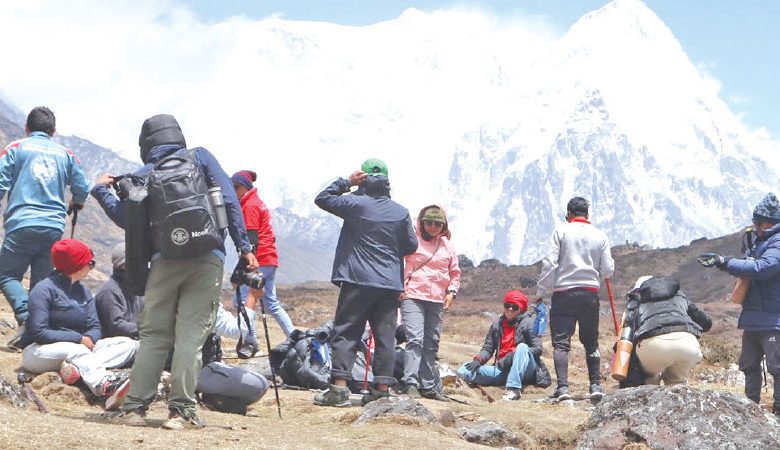
Photo: Sahara Limbu Tourists at Oktang, the southern base camp of the Kanchenjunga region.
By Our Correspondent,Phungling, Oct. 14: Tourist arrivals have begun to rise in the Kanchenjunga region of Taplejung, home to the world’s third-highest mountain.
Tourist activity has increased with both domestic and international visitors during this year’s trekking season, which began in
early September.
According to Tashi Tenzing Sherpa, tourism assistant at the Ghunsa Tourism Checkpost of the Kanchenjunga Conservation Area Management Council, around 170 foreign tourists had visited the Kanchenjunga region by Monday this season.
Some have already reached the base camps, while others are resting in areas such as Ghunsa. Tourism entrepreneurs said tourist arrivals had increased compared with
last year.
The Kanchenjunga region has two main tourist seasons each year. The first runs from March to May, while the second lasts from September
to December.
During the current autumn season, tourists have arrived mainly from countries including France, Australia, Germany and the United States.
Local business owners estimate that the number of domestic tourists is twice that of foreign visitors. However, separate records of domestic tourist arrivals are not maintained systematically.
With the rise in tourist arrivals, hotels, lodges, restaurants and trekking services have become busier. During the Dashain and Tihar festivals, Nepali tourists often visit the Kanchenjunga region with their families.
According to hotel operator Serap Sherpa, hotels and lodges in Ghunsa and surrounding areas are often fully occupied during the festive period. This has boosted the morale of local business owners.
Tourism entrepreneur Pema Sherpa said tourist arrivals had increased this year compared with last year. Another tourism entrepreneur, Phupuchhohang Sherpa, said the rise in visitor numbers had created income-generating opportunities for trekking guides, porters, transport operators and businesses selling local products. As foreign tourists tend to undertake longer treks, demand for guides and porters has also increased.
The Kanchenjunga region has two main base camps, the northern and southern base camps. To reach the southern base camp at Oktang, travellers must journey from Phungling via Japantar to Ghunsa.
From Ghunsa, the base camp, situated at an altitude of approximately 5,200 metres, can be reached after a further three days of trekking.
To reach the northern base camp at Pangpema, trekkers must travel from Phungling via Yamphudin and undertake a trek of approximately three days.
Local hotels, homestays and guide services are available along the trekking route leading to this base camp, which lies at an altitude of around 4,800 metres.
However, adverse weather conditions continue to affect tourism in the region. According to Kancha Sherpa, a hotel operator in Ghunsa, heavy rainfall during June and July often obstructs trekking routes, while snowfall from December to February makes travel difficult.
To ensure sustainable tourism in the Kanchenjunga region, improvements to trekking trails, signposting, safe accommodation, first-aid centres and emergency rescue services are needed. Giving equal priority to conservation and tourism, while increasing local community participation, is expected to create further employment and income-generating opportunities in the area.
The Rising Nepal