By Rammani Dahal, Makwanpur, Aug. 24: A new initiative to rescue and rehabilitate naturally grown banyan and peepal saplings has been launched in Makwanpur.
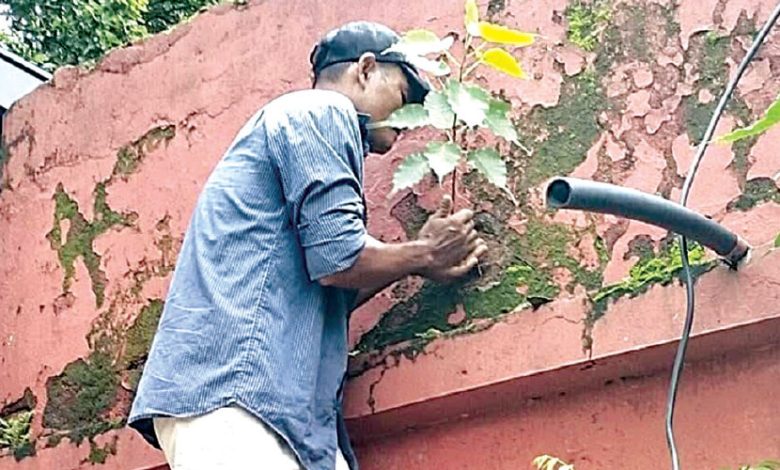
Banyan and peepal saplings growing on government offices, public buildings, within building compounds and along boundary walls not only make the structures look untidy but also pose a growing risk of weakening and shortening the lifespan of the structures.
The Division Forest Office, Makwanpur, has started removing and rehabilitating banyan and peepal saplings growing on the walls and within the compounds of government offices and public buildings in Hetauda.
Rakesh Prasad Chandrabanshi, chief of the Division Forest Office, said the rescued banyan and peepal saplings would be raised at forest nurseries before being planted at suitable locations.
He said that around 300 saplings of the two species had been collected from the premises of the Division Forest Office, District Administration Office, Ministry of Economic Affairs and Planning and the Office of the Chief Minister.
“This campaign is important from the perspective of religious, cultural and biodiversity conservation, which is why we have initiated it,” said Chandrabanshi.
Chandrabanshi said the banyan and peepal saplings raised at the nursery would be provided, based on demand, to community forest user groups, religious forests and religious sites.
The initiative to be expanded across province
The initiative launched by the Division Forest Office, Makwanpur, to rescue and manage banyan and peepal saplings will now be expanded across Bagmati Province.
The Ministry of Agriculture, Livestock Development, Forest and Environment of the Bagmati Province government has shown interest in the initiative and directed all 15 Division Forest Offices in the province’s 13 districts to rescue, manage and plant banyan, peepal and shami saplings.
The ministry issued the directive following a secretary-level decision to manage and plant the three species.
Madan Kandel, chief of a division at the ministry, said a secretary-level decision had been made to direct the Division Forest Offices to coordinate with the concerned agencies to safely collect naturally grown banyan, peepal and shami saplings from government buildings and other structures and raise them at nurseries under the respective Division Forest Offices.
The ministry has also directed the offices to arrange for the planting and distribution of the saplings raised in this manner to local communities, religious and cultural organisations and other suitable locations as required.
The directive states that banyan, peepal and shami trees hold great religious, cultural and environmental significance in Nepali society. It notes that these trees, have traditionally been preserved and worshipped at chautaras, religious and cultural sites and various locations in urban areas.
The directive also emphasises that conservation and management of these species is essential given their significant contribution to biodiversity and the environment.
Chandrabanshi said banyan and peepal trees were important as they provide food and shelter for birds, bats, squirrels, monkeys and other wildlife.
The Rising Nepal