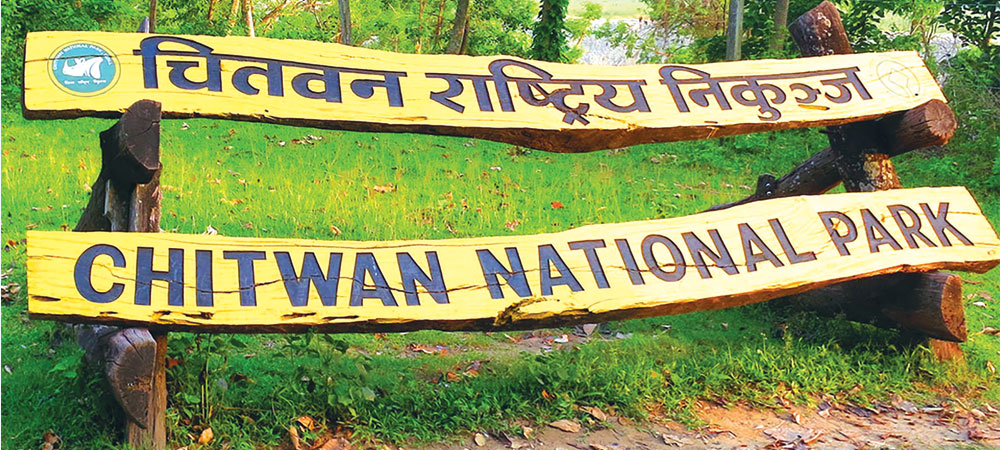
Chitwan National Park, the first protected area of the country.
Indira Aryal
KATHMANDU, Sept. 23: Over the past five decades, Nepal has reached its upper level in the conservation of various species. With conservation of species including floral and faunal, and conservation of natural ecosystems from the lowland Terai region to the high Himalayas, the country has become one of the successful countries in terms of conservation.
The recent achievement of international commitment to doubling the tiger population to zero poaching in endangered one-horned rhino to the expansion of protected areas, the country gets recognized at the international level for enduring efforts in protecting the species. The country is diverse in terms of geographical layout so is the home to different floral and faunal species, and natural ecosystems.
The conservation drive started with the establishment of Mahendra Deer Park Chitwan National Park (CNP) in 1973 with the formulation of the National Parks and Wildlife Conservation Act.
At that time, the concept of conservation started with the idea of species conservation, said Tirtha
Bahadur Shrestha, senior biodiversity expert.
Later on, when there was a need to protect the habitat of species like one-horned rhinos, elephants, and tigers, the first national park of the nation, CNP was established with the aim of conserving and protecting threatened species in their own habitat. Afterwards, various other national parks and protected areas were established with the concept of species conservation.
According to Shrestha, again there was a need to conserve the whole environment to protect the species and their habitats but the problem of human-wildlife conflict arises with the species conservation, Shrestha said.
To solve the problem of human-wildlife conflict, the concept of a buffer zone was started.
Later on, the concept of the landscape approach rose with the interest in large mammal conservation. The government has already initiated Western Terai Landscape Project and Terai Arc Landscape Project to save large wild mammals from extinction. But now the focus shifted to human need conservation from species conservation in the initial phase, Shrestha said.
The conservation is need-based now, he added. So the concept of community forest was introduced and integrated with agriculture. They are supporting conservation now. “Humans are the ones who play the role in conservation and again they play the role in destruction as well,” he said.
Former Director General at the Department of National Park and Wildlife Conservation and wildlife expert Dr. Ram Chandra Kandel said that the conservation drive was started at Mahendra Deer Park in Chitwan in the early 60s when the number of rhinos started to decrease drastically from around 900 at that time. CNP was established later seeing the ecological significance and value of the area as the Deer Park was not sufficient to conserve the larger regions.
“The community was not a matter of priority at that time. But later on with the existing human-wildlife conflict, community people have put a priority to conservation and established buffer zones and community forests,” Dr. Kandel said. Now people have been benefited due to the establishment of conservation parks. Their livelihood has changed, opportunities have been created with the operation of hotels around the protected areas, he added.
See Page 6
According to herpetologist and conservation expert Karan Bahadur Shah, the country is getting more success in the conservation protecting rare and threatened species. “We only try to spot out negative aspects but there are a lot of positive changes and gains in the conservation sector in Nepal,” Shah said.
Conservation efforts made by the government of Nepal with the help of various national and international organisations are popular worldwide and highly recognized by international community, he added.
According to the Department of National Parks and Wildlife Conservation, there are 12 national parks, one wildlife reserve, one hunting reserve, and six conservation areas and 13 buffer zones extending from lowland Terai to high mountains.
Each national park has its own buffer zone to facilitate human-wildlife co-existence. More than 23 per cent of Nepal’s total area is declared as protected area. There are two national parks that have been enlisted as world heritage sites by the UNESCO.