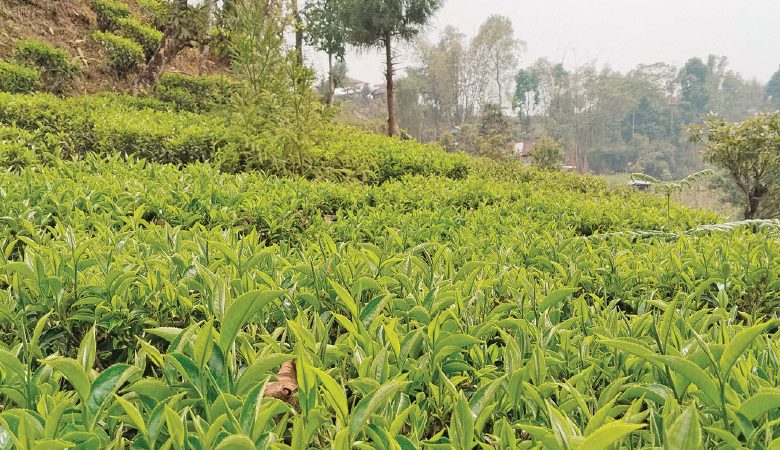
By Kokila Dhakal, Ilam, June 19: After the export of tea worth millions of rupees annually came to a halt, tea farmers and entrepreneurs have said that the government should now pursue third-country markets as an alternative outlet for the Nepali tea.
They argue that as India repeatedly imposes restrictions on Nepali tea exports and informally disrupts trade, alternative markets beyond India have become necessary.
“Farmers, tea producers, and the government should see the disruption in tea exports to India not as a problem but as an opportunity. It is time to break the illusion that India will always remain Nepal’s sole market. This is also an important opportunity for the current government,” said Grishma Subba, proprietor of Jasbire Tea Industry in Jasbire, Ilam.
“The closure of tea factories during the peak tea season has pushed small farmers to the brink of losing their livelihoods. A long-term solution must be sought for this recurring issue,” she added.
Subba, who exports tea to more than seven countries, including China, Germany, and Russia, said the easiest and most viable option now would be for the government to move forward with a government-to-government (G-to-G) trade agreement with China.
“Nepali tea sells well in China, and Chinese traders are interested in importing it. Tea exported to China could also reach global markets through Chinese channels. India should not be seen as the only option. Even now, Chinese traders are willing to come to Nepal, but there is no formal trade agreement in place,” said Subba. “At present, we have to send tea in small quantities via courier.”
Uday Chapagain, proprietor of Sundarpani Tea Estate in Suryodaya Municipality, Ilam, who has been exporting tea to third countries since 2009, also believes that third-country markets are the best alternative for Nepali tea.
“Tea certified organic by the Swiss organisation IOM and exported to nine countries has recently been questioned by India. It is impossible that tea certified for third-country exports would fail laboratory testing in India,” Chapagain said.
“Tea from the same plant cannot partly be organic and partly non-organic. This clearly indicates India’s attempt to obstruct Nepali tea export.”
Chapagain further argued that Indian factories located near the Nepal-India border purchase Nepali green tea leaves, process them under Indian branding, yet reject tea processed in Nepal itself as uncertified, which he described as further evidence of unfair restrictions. Having just returned from a month-long tea-related programme in Germany, Belgium, Luxembourg, the Netherlands, and the United Kingdom, Chapagain said the government should adopt economic diplomacy and facilitate tea exports to third-country markets.
“The market for the tea currently being blocked remains favourable. Nepali tea could be exported successfully to countries such as Turkey, Pakistan, Iran, and Gulf nations. However, this cannot happen solely through the efforts of entrepreneurs. The government must take the lead,” Chapagain said.
“The quality of Nepali tea is superior to Indian tea. India’s strategy appears to be driven by concerns over lower domestic quality and stronger demand for Nepali tea,” he added.
Chapagain, whose Gorkha Tea Estate has won several awards including the Nepal Best Export Award and an international award in China, insisted that India’s allegations against Nepali tea would have little impact.
“A recently sent tea sample to China has passed inspection, and preparations for exports are under way. Inspectors from IOM’s Bangalore office recently completed organic certification inspections at the farms of 250 farmers,” Chapagain said.
“Questioning the quality of Nepali tea will not solve anything. The government must support tea entrepreneurs by helping them reach potential markets and enabling Nepali embassies abroad to facilitate connections with foreign traders.”
Despite operating tea factories even during the COVID-19 pandemic, Chapagain remains committed to keeping his fully organic tea production running during the peak season.
“I have repeatedly discussed the issue with the government, including the Ministry of Finance, Ministry of Foreign Affairs, Ministry of Agriculture, ministers, and secretaries. Discussions on expanding tea exports to third countries will continue,” he said.
“The government must recognise Nepali tea as a long-term national asset.” The Central Tea Cooperative Federation (CTCF), an organisation representing tea farmers, has urged the government to ensure market management for Nepali tea and create conditions for the reopening of closed factories.
In an appeal, the federation warned that factory closures during the peak tea season threaten the livelihoods of small farmers and called for the establishment of a tea auction centre within Nepal. It also urged the government to open access to third-country tea markets.
Meanwhile, Indra Adhikari, a representative of the National Tea and Coffee Development Board, said the resolution of the current crisis depends largely on government intervention.
“Tea must be plucked 36 to 40 times a year, and even a delay of two days affects quality. Therefore, a solution must be found quickly,” Adhikari said. “Diplomatic engagement is the first necessary step, and we have been urging the government accordingly.”
However, farmers and entrepreneurs say they remain largely unaware of what the government is doing regarding the tea issue.
“We received a phone call from the Prime Minister’s Secretariat asking us to submit written recommendations on how the tea issue could be resolved,” he said.
“We submitted our suggestions yesterday, but we do not know what will happen next,” said Gopal Kattel, general secretary of the Suryodaya Tea Producers Association.
“Previously, we had repeatedly discussed tea-related problems and market issues with the Prime Minister and relevant ministries, but no concrete action has yet been taken.”
Since tea factories shut down on June 15, thousands of kilograms of green tea leaves are at risk of going to waste in farmers’ gardens.
The Rising Nepal