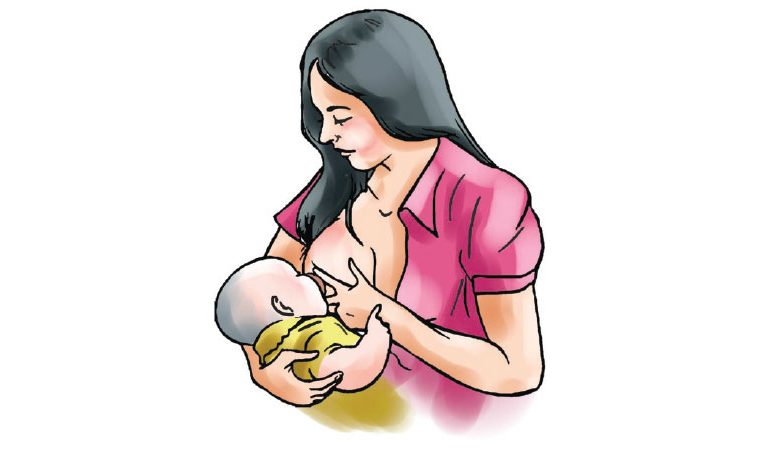
By Lalit Basel, Surkhet, June 18: Karnali and Sudurpaschim provinces have emerged as the leading provinces in Nepal for exclusive breastfeeding, with the highest proportion of infants being exclusively breastfed from birth until six months of age.
According to a health survey, 74 per cent of mothers in Karnali exclusively breastfeed their infants. Sudurpaschim Province also recorded the same rate of 74 per cent, while the figures were lower in other provinces. Lila Bikram Thapa, a nutrition specialist at the Family Welfare Division under the Ministry of Health and Population, said that while the national rate of exclusive breastfeeding up to six months stands at 56 per cent, Karnali and Sudurpaschim have achieved significantly higher rates of 74 per cent.
The lowest rate was recorded in Lumbini Province at 36 per cent, followed by Bagmati at 43 per cent, Koshi at 53 per cent, Gandaki at 64 per cent, and Madhes at 65 per cent.
According to Thapa, exclusive breastfeeding for the first six months is essential for a child’s growth and development, and Karnali and Sudurpaschim are performing better than other provinces in this regard. Similarly, Karnali Province has the lowest rate of bottle-feeding. According to Thapa, only 11 per cent of infants in Karnali are fed using feeding bottles.
Bottle feeding high in Bagmati
Bagmati Province has the highest rate of bottle feeding at 43 per cent, followed by Gandaki at 27 per cent, Koshi at 25 per cent, Lumbini at 24 per cent, Madhes at 22 per cent, and Sudurpaschim at 15 per cent.
Nationally, around 12 per cent of infants are fed using feeding bottles. Bottle-feeding is more common among affluent, educated women. Nearly 49 per cent of women with higher education feed their infants using bottles, compared to only 12 per cent among women with no formal education.
Health experts recommend initiating breastfeeding within one hour of birth, feeding infants exclusively with breast
milk for the first six months, and then introducing nutritious complementary foods alongside continued breastfeeding from six months onwards.
Breastfeeding should continue for at least two years. However, Thapa expressed concern that changing lifestyles and modern perceptions have led to an increasing trend of replacing breastfeeding with formula milk.
Failure to breastfeed significantly increases the risk of infant mortality.
According to Thapa, infants who are not breastfed within the first hour after birth are three times more likely to die.
They are also more prone to repeated episodes of diarrhoea, frequent illnesses, severe infections, and malnutrition.
In addition, a lack of breastfeeding can weaken the bond between mother and child, make children feel less secure, reduce cognitive performance, and increase the risk of chronic diseases later in life, including heart disease, diabetes, cancer, and asthma.
Although various infant formula products are available on the market as substitutes for breast milk, he said they do not provide the same benefits as a mother’s milk.
Shyam Prasad Paudel of the Public Health Service Office, Surkhet, said that although many breast milk substitutes are being sold in the market, there should be stronger monitoring of their sale and distribution.
Since local governments are responsible for monitoring such products, he suggested that they should carry out more effective oversight.
However, local authorities have not yet taken action against businesses selling breast milk substitutes, and such products continue to be sold openly.
Sharmila BK, Secretary at the Ministry of Social Development, stated that no legal action has so far been taken against sellers of infant formula products, although awareness efforts have been conducted.
She also informed that the open promotion and sale of such products is not permitted.
The Rising Nepal