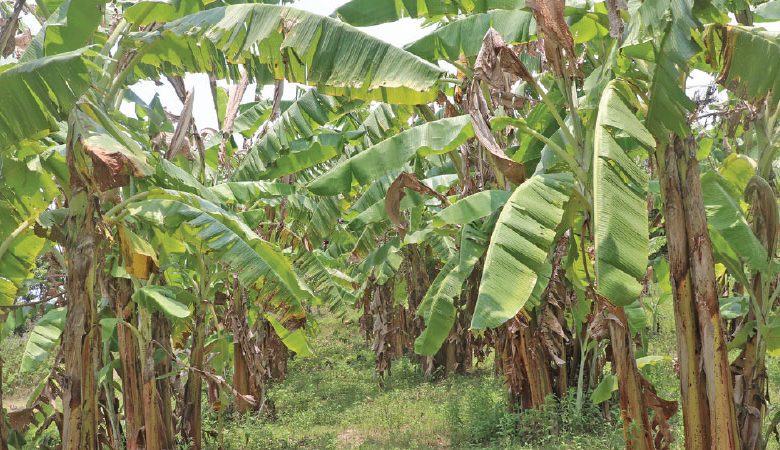
Photo: TRN Banana plantation in the Bhulke area of Pakhribas Municipality-8, Dhankuta.
By Kaviraj Ghimire, Hile, June 21: A shortage of farm labour is encouraging farmers in Pakhribas Municipality-8 of Dhankuta to switch from traditional crops to commercial banana farming.
Bhairav Bahadur Rai, a local of Pakhribas Municipality, has been cultivating bananas on around 26 ropanis of land. He previously grew maize, paddy and other crops, but turned to banana farming a few years ago after finding it increasingly difficult to hire farm workers.
Now in his old age and living alone, Rai said banana farming has become a practical alternative. “I have spent my whole life farming, but it is no longer possible to grow labour-intensive crops. Bananas provide better returns than cereals, and once the saplings are planted, they require much less labour,” he said.
Gangaram Rai of Agrakhe village also switched to banana farming four years ago and now grows bananas on about 15 ropanis of land. He said the farm currently earns him around Rs. 5,000 a week, with income expected to increase as production expands.
Unlike many other crops, banana growers do not have to search for buyers. Traders visit the village once a week and buy the fruit directly from the farms for around Rs. 50 per dozen.
In recent years, many farmers in Pakhribas Municipality-8 have abandoned traditional paddy and maize cultivation in favour of bananas. Land that was once left uncultivated because of labour shortages is now being used for banana farming, providing farmers with a more reliable source of income.
Most farmers around the Bhulke wetland area have adopted banana cultivation. Villages such as Malbanse and Agrakhe now depend heavily on banana farming for household income.
According to Ward Chairperson Ganesh Rai, around 40 families in the ward are engaged in banana farming. Most cultivate between five and 30 ropanis, and more farmers are joining each year as labour shortages continue to affect conventional farming.
Farmers in the area grow several banana varieties, including Jahaji, Malbhog, Chiniya Champa and Assamese. Although each banana plant produces fruit only once, new suckers emerge from the base and replace the old plant. With proper weeding, fertiliser application and irrigation, the plantation can continue producing for many years. New plants usually bear fruit within a year.
Nagendra Rana Magar, chief of the Agriculture Knowledge Centre, Dhankuta, said farmers in neighbouring local units, including Sahidbhumi Rural Municipality, Chaubise Rural Municipality and Sangurigadhi Rural Municipality, are also increasingly taking up banana cultivation. Bananas are currently grown on 43 hectares of land across the district, producing around 400 metric tonnes annually.
The Rising Nepal