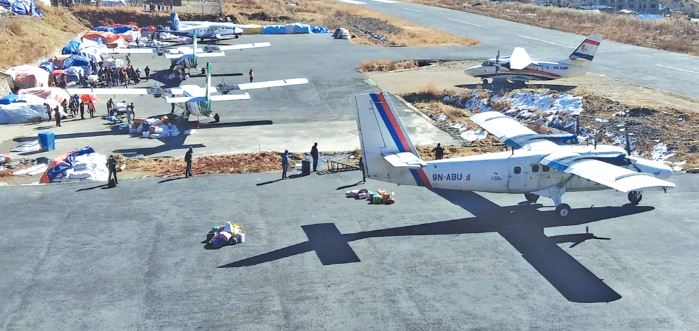
By A Staff Reporter Kathmandu, June 11: Nepal has failed to ensure aviation safety in the expected manner despite improvements in regulatory and organisational framework.
According to the report presented by the Aviation Safety Investigation Committee to the Ministry of Culture, Tourism and Civil Aviation (MoCTCA) on Wednesday, Nepal needs to bring about a total paradigm shift to meet the international standards of air safety.
The Committee analysed the International Civil Aviation Organisation’s (ICAO) safety audit report for Nepal as well as the Civil Aviation Authority of Nepal’s (CAAN) Safety Management System (SMS) audit and conducted interviews with various stakeholders. Based on these, it concluded that Nepal’s air transport sector faced numerous challenges
that need to be addressed through the formulation of short-, mid- and long-term plans.
The five-member committee, led by Joint Secretary Buddhi Sagar Lamichhane of the Civil Aviation Division of MoCTCA, found that CAAN’s set-up, as the organisation in-charge of both issuing air operation certificates and ensuring compliance and maintenance, presented significant conflicts of interest. The organisation also lacks several units that are crucial for its functioning, it noted.
It has further stated in the report that the lack of manpower and resources to establish a separate regulatory body for helicopters poses a challenge for the sustainable operation of chopper services in Nepal.
The Aviation Policy of 2006 requires all domestic airline operators to have three aircrafts but CAAN only needs them to have two crafts (one for charter and non-schedule flight operators). The report has called this a lack of legal clarity between the policymakers and regulators.
It has also highlighted the lack of rules regarding the age, economic design life or pressurisation cycle of aircrafts in operation in Nepal.
The regulators in the country have not been provided with sufficient rights to carry out their responsibilities properly.
The report also found that CAAN shows the presence of safety-related technical manpower on paper to meet
ICAO’s requirements but has not been able to mobilise them effectively in the field.
It also calls out the Flight Safety Standards Department in particular and states that its practice of assigning an officer to inspect the same airline for a long time and the lack of proper division between officers who carry out field work and those who carry out office work has affected its ability to work.
The 50-page report explicitly states that Nepal’s safety compliance only appears good on paper and is unsatisfactory in practice. “Lack of manpower, weak
organisational governance, aviation safety activities focused on process rather than results and lack of accountability have prevented CAAN from carrying out its regulatory functions,” it states, calling for the strengthening of the Authority’s regulatory and supervisory role.
The report provides 14 short-term, 12 mid-term and three long-term suggestions for relevant bodies to carry out to improve safety in the Nepali sky.
These findings are based on the shortcomings the Committee identified through its investigation.The Rising Nepal