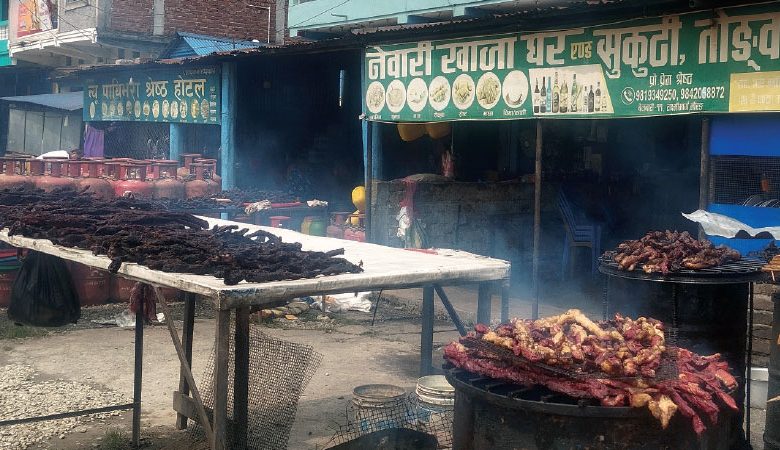
By Hariprasad Koirala,Urlabari, June 24: The illegal export of male buffaloes from Nepal to India has increased, leaving Nepali meat and dried meat producers struggling to secure enough animals for their businesses.
According to traders, Indian buyers regularly visit major livestock markets in Koshi Province, including Inaruwa in Sunsari, Belbari and Mangalbare in Morang and Damak and Dhulabari in Jhapa, to purchase buffaloes.
While a water buffalo sells for around Rs. 150,000 in Nepal, Indian traders are reportedly offering up to Rs. 170,000. They have also started booking animals directly from farmers in villages, making it difficult for Nepali businesses to compete.
Dilip Shrestha, who runs a branded buffalo meat and dried meat business in Laxmimarga, Belbari-11, Morang, said farmers no longer sell their animals to local traders.
“Indian buyers come directly to farmers’ homes and pay Rs. 20,000 to Rs. 25,000 more than we can offer. We simply cannot get enough buffaloes,” he said. Shrestha slaughters one buffalo each day for his business, which he started five years ago. Besides providing him with a stable income, the business has also created local jobs.
His shop, Shrestha Buffalo Meat Shop, requires around 30 to 32 buffaloes every month. A single buffalo typically produces between 150 and 220 kilograms of meat.
Boneless meat currently sells for Rs. 700 per kilogram, while bone-in meat is priced at Rs. 600 per kilogram. Shrestha said prices have risen over the past three months because of the shortage of buffaloes.
“If these animals were not being taken to India, meat would cost no more than Rs. 500 per kilogram. We have had to raise prices because supplies are so limited,” he said.
Demand for dried buffalo meat is even higher than for fresh meat. Shrestha said it takes about 3.5 to 4 kilograms of fresh meat to produce one kilogram of dried meat. Drying is easier during sunny weather, but in the monsoon season the meat must be dried using fire.
Although his business sells five to six kilograms of dried meat each day, he said production cannot keep up with demand. Orders come regularly from hotels and businesses in larger cities, but he struggles to meet even the needs of local hotels.
Dried buffalo meat has also become a popular gift item. Besides Nepali migrant workers travelling abroad, many Nepalis living overseas also take it with them. It currently sells for Rs. 2,700 per kilogram.
Shrestha is not the only businessman affected. Other traders in Laxmimarga, including Prem Shrestha, Tanka Shrestha, Gagan Shrestha, Ram Tamang and Sobhit Shrestha, are also involved in the buffalo meat and dried meat trade. Some slaughter buffaloes themselves, while others buy meat from the market and process it into dried meat.
Although traders say buffaloes are being taken illegally to India, Devaraj Neupane, Information Officer at the Trade and Export Promotion Centre in Biratnagar, said Nepal’s livestock trade has been declining over the past three years, leading to a sharp rise in the trade deficit.
During the first nine months of the current fiscal year, the livestock trade deficit reached Rs. 404.88 million. Nepal imported livestock worth Rs. 441.47 million while exports totalled only Rs. 36.59 million, resulting in a trade deficit of 91.7 per cent.
Dr. Bidur Prasad Gautam, chief of the Animal Quarantine Office in Biratnagar, said illegal movement of livestock into India has increased, particularly in the evenings when animals are taken across the border under the pretext of grazing.
Locals said livestock is commonly smuggled through border routes at Betauna, Bardanga, Sikti and Kutumganj in Morang, and Juddhaganj in Sunsari.
Dr. Gautam said that since the 2018/19 fiscal year, not a single animal has been officially exported through the Animal Quarantine Office with health certification and approval.
The Rising Nepal