The Rising Nepal
By Laxman Kafle
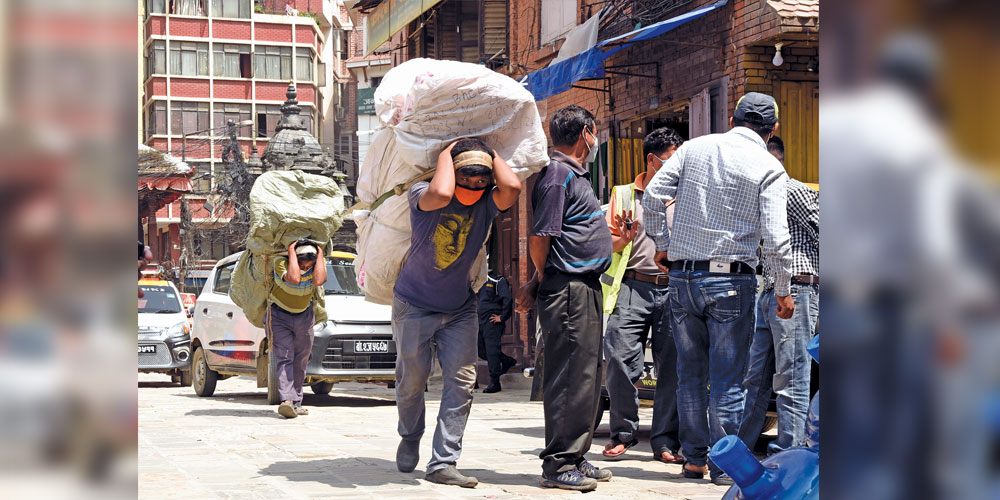
Kathmandu, Sept. 11: Carrying a namlo (head strap), Ram Bahadur Dhalkuti of Ramechhap roams around New Road looking for work every day. Even at the age of 55, he carries a heavy load on his back for a few hundred rupees if he is lucky enough to find work.
He has been working as a porter in the New Road area for the last three decades. With wrinkles in his face, he is still carrying the loads of local business houses. However, he looks worried and unstable these days, as what he earns is not enough to meet his expenses.
“Dashain is around the corner, but I have not a penny in my pocket to manage Dashain expenditure,” he said, when asked how much he earned by working as a porter.
He said rising prices and fast approaching Dashain have only added woes to him and other porters.
“Due to skyrocketing prices of goods, our daily expenses have also increased. Managing expenses for Dashain has become an additional challenge,” he said while looking towards New Road Gate, towards which other porters were running.
He said that he had no option but to work as a porter in lack of education. According to him, job of a porter is arduous and the earning is little. “Our income has further decreased after the COVID-19 pandemic,” he added.
Still, he said that he was planning to celebrate Dashain with family in Ramechhap even by borrowing money.
According to him, he earns about Rs. 500 to Rs. 800 a day by carrying heavy loads. Out of that, he spends around Rs. 250 for meals in the morning and evening.
“I have to pay Rs. 3,500 rent every month. It is difficult to save even around Rs. 5,000 to Rs. 7,000 a month. Besides, I have to send money home for household expenses every month,” he said.
He said he needed at least Rs. 40,000 to celebrate the festival, which he cannot earn in three weeks. Dashain is just three weeks away.
Like Dhalkuti, Nirmal Pariyar of Sindhuli also said that managing expenses for Dashain and Tihar was the biggest challenge for him.
Pariyar landed in New Road recently to work as a porter quitting his job at a construction site after the contractor paid him very low wages. But within a few days, he discovered that he had jumped out of the frying pan into the fire.
“It seems this job of a porter will also not help me meet my household expenses,” he said.
Of course, the tales of these two poor porters match with the situation of many others including the employees who live on fixed pay because of ever-rising prices of goods ranging from daily consumption items to clothing and transportation fares.
According to businessmen, prices of ready-made clothes, shoes and electrical appliances will be 20 per cent higher this Dashain than last year. The transportation fare has already increased by above 30 per cent and consumable goods by 15 per cent this year than last year due to the price hike of petroleum products. In the meantime, the aviation fare has also increased significantly.
Increment in the transportation fare adds an additional financial burden to the people to go to their hometowns from Kathmandu to celebrate Dashain.
The prices of all items have gone up significantly due to the Ukraine-Russia war and a strong US dollar.
Since most of the goods have to be imported from abroad, all the goods coming to Nepal have become expensive because of the rising dollar value.
No matter how expensive the goods are, people have already started thronging shops to buy goods for Dashain. It is evident from the growing crowds at the shopping malls, fancy shops as well as retail shops. But the wage earners like Dhalkuti and Pariyar are still searching for loads to carry and make money for the festival.
Even those who have started shopping said that they were worried by sharp rise in prices of goods.
Sita Dhital of Kalanki, who was found shopping at Pako, New Road, said that clothes were more expensive this year than last year.
“I visited many shops to buy clothes for my children and myself. But I could not buy the clothes as per the needs because of their high prices,” she said.
She said that the price of garments had almost doubled in two years.
Not only the clothes, but also other essential goods have become expensive this year, she said, adding that the skyrocketing prices would make it difficult to manage expenditure to celebrate the festivals.
Burden to the poor
As Dashain is the festival at which people buy and wear new clothes, eat delicious meals and travel to receive Tika from seniors, they need more money. When prices go high, their expenses also increase.
As a result, many people with poor financial condition seek loans while others have to work days and nights to increase their income.
Managing money has been a great challenge, especially for lower class people, said economist Dr. Chandra Mani Adhikari.
He said that the middle and lower class families get affected more while celebrating great festivals when the inflations run high.
“Normally, Dashaina and Tihar are the times to spend for consumption and wearing clothes and purchasing new devices according to one’s financial situation. They look forward to Dashain to wear new clothes and eat delicious foods, but due to the increase in prices, they are unable to buy the things they need,” he said.
People also sell their property and use the savings to celebrate Dashain.
Many are likely to be more affected during this situation of stagflation as the inflation will increase against low and stable economic growth and the income of the people, Dr. Adhikari said.
The income of people could not increase in line with the inflation which hits the purchasing power of people which has also affected the business.
For a poor, daily wage earner like us it is difficult to make ends meet, porter Pariyar said, adding that the festivals add mental and financial burden to them. Dashain will add to the debt on the head of the poor people who are forced to take loans to celebrate it.
“Consumers have already felt the heat of skyrocketing price hikes and their impact on their daily life. So, it is necessary to control the unnatural price hikes in the market during the festivals,” Dr. Adhikari said.
The consumption stands at around 40 per cent of the total annual consumption in two months of Dashain, Tihar and Chhath. However, due to price hikes, the consumption of goods in terms of quantity will be low even if they spend more in this year’s festivals.
No expected business
Like the poor porters, the businessmen operating their shops in the Kathmandu Valley, including New Baneshwor, do not look happy this time as they have been unable to do expected business even on the eve of the festivals.
Only a negligible number of customers are visiting the shops to buy goods, said Anjana Ghimire, proprietor of Diamond Collection of New Baneshwor.
“It is impossible to boost sales until and unless the income of people improves. Price hike on fancy items and shoes has also affected our transactions,” she said.
The price of a pair of pants was Rs. 1,600 last year, but it has reached Rs. 2,000 today. The price of fabrics has been increasing significantly for the last few years.
The prices of pants, T-shirts and shirts have gone up by 20-25 per cent in a year. The prices of goods imported from abroad, including China, India and Bangladesh, are hiked significantly this year.
“I think that business won’t be satisfactory in Dashain. But it might be better than the period of COVID-19 as the flow of people has started increasing,” she said.
Dashain goods stuck in China
Meanwhile, after China closed the customs points connected with Nepal due to the spread of COVID-19, hundreds of containers carrying goods are now stranded in Tibet, China.
Since the Nepalese side has not received any information about the opening of the border, the possibility of goods being brought targeting Dashain to reach Nepal before Dashain has been slim, said Naresh Katuwal, former president of Nepal National Federation of Entrepreneurs.
More than 400 containers carrying Dashain targeted goods, including electronics, clothes, edible foods and fruits are stopped in Kerung and their arrival in Kathmandu before Dashain looks impossible, he said.
“On the one hand, the goods brought for Dashain are stuck in China, and the retailers and other businessmen have been unable to purchase goods from other destinations as they cannot get loans from banks and financial institutions and cooperatives on the other,” Katuwal said. Many businessmen might be displaced due to increased bank interest and lack of new loans to continue their business. The traders will sell stocked goods this Dashain in lack of new arrivals, he said.