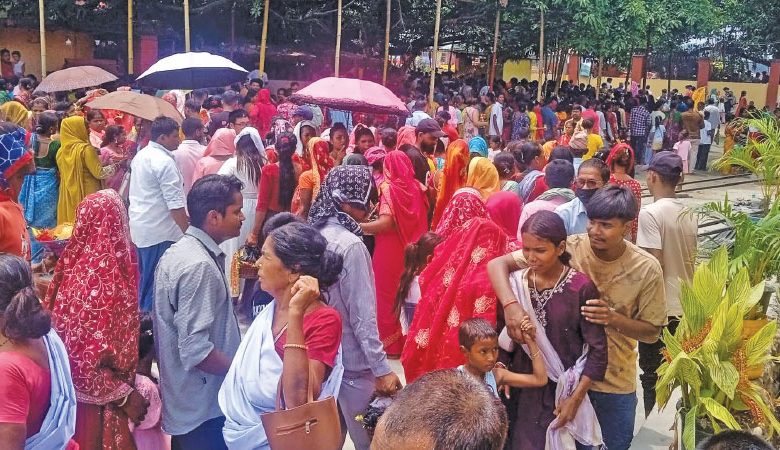
Photo: Baburam Karki/ TRN Akhari Puja being performed in Ward No. 1 of Ramdhuni Municipality.
By Babu Ram Karki, Barahakshetra, June 30: The historic and religious tradition of Akhari Puja, associated with nature, crops, and the collective security of the Tharu community, has begun in Tharu settlements.
This worship, performed at village shrines from the first day of the bright fortnight (Shukla Pratipada) of Asar month to full moon (Purnima), has long been observed by the Tharu community as an important part of their indigenous culture.
Sagen Chaudhary, District President of the Tharu Welfare Assembly, said that the Tharu community begins the worship by choosing an auspicious day to perform rituals for the village deity and the family deity.
He said that during Akhari Puja, offerings of rice pudding (kheer), sacred rice (akshata), and betel leaves are presented to the village and family deities while praying for peace in the village, the safety of children, protection of crops, and protection from natural disasters.
The rituals include traditional musical performances using instruments such as the cymbal (jhyali) and drum (madal), along with ancient devotional songs dedicated to the deities.
Shamans perform ritual dances and ceremonies during the worship. It is also customary to offer special prayers to local deities, including Bichhu Dhami and Rajaji, followed by worship of the goddess.
Traditional indigenous varieties of rice are offered during the ceremony.
According to Adhik Lal Chaudhary, the rice used for the rituals must be hand-pounded in a traditional wooden mortar, in keeping with religious beliefs and customary practices.
He added that the main feature of Akhari Puja is the offering of rice pudding prepared from these traditional indigenous rice varieties. A portion of the rice is set aside as sacred rice, while the remainder is cooked into rice pudding and offered according to religious procedures.
Akhari Puja is not only a religious ritual but also symbolises harmony with nature and community unity. There is a strong belief that if the rituals are properly performed at the village shrine, the village, households, and farmland will remain safe and prosperous.
This tradition has been passed down through generations based on the belief that it protects people from negative natural forces and brings positive energy.
According to Sunil Chaudhary, priests invite the deities through traditional chants and ancient devotional songs before conducting the worship.
He said that the village shrine is not merely a place of worship but has become a living center for studying the Tharu community’s history, culture, customs, way of life, and collective social traditions.
In recent years, awareness campaigns have also been conducted at various local levels to promote the conservation of village shrines and recognition of their cultural importance.
The Tharu community in different villages of Sunsari district is celebrating Akhari Puja with great enthusiasm. The tradition, which honours nature, the land, and ancestors, continues to be preserved and passed on from one generation to the next.
The Rising Nepal