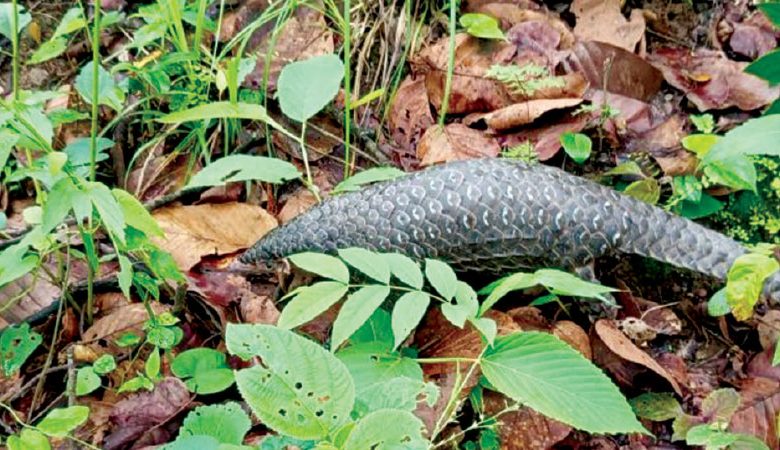
By Anil Parajuli, Hetauda, July 2: Sightings of the endangered pangolins have become increasingly common in Makwanpur in recent months.
According to the Division Forest Office, greater public awareness of conservation, active protection efforts by community forests, and a growing pangolin population have led to more animals venturing into settlements and roads in search of food.
On Tuesday morning, a black pangolin weighing around four kilograms was found at Chaughada Bazaar in Hetauda Sub-Metropolitan City-16.
The animal was rescued by the Rani community forest user group and safely released into a pangolins conservation centre located within the forest. A total of seven pangolins have been found during the past two and a half months this year.
The Rani community forest user group has been running a pangolins conservation programme since 2005. Its initiatives include managing suitable habitats, protecting termite mounds, conducting public awareness campaigns, and promoting conservation education in schools.
The group has also erected pangolin statues at Chaughada Bazaar and Peace Park, and built a specialised enclosure within the forest for rescued animals. It estimates that more than three dozen pangolins currently inhabit the forest area.
According to the Division Forest Office, pangolins are present in more than 150 community forests across Makwanpur. The Rani and Chuchchekhola Community Forests have been caring for rescued Chinese and Indian pangolins recovered from various locations.
During the last fiscal year alone, Chuchchekhola Community Forest rescued and protected 23 Chinese and two Indian pangolins.
Bishnu Prasad Acharya, divisional forest officer at the Chitwan Division Forest Office, said that as the pangolin population increases, food sources become scarcer, prompting the animals to enter settlements and roads in search of food.
He added that growing public awareness has significantly reduced the killing and illegal trade of pangolins compared with the past. Conservation activities are currently under way in Makwanpur, Dhading, Sindhuli, Chitwan, and other districts of Bagmati Province, where pangolins are found throughout the province.
Kumar Poudel, director of Greenhood Nepal, said that increasing public awareness has made pangolin rescue and conservation efforts more effective. Of the world’s eight pangolin species, Nepal is home to two, the Chinese pangolin (also known as the black pangolin) and the Indian pangolin (also known as the brown pangolin).
The International Union for Conservation of Nature (IUCN) classifies the Chinese pangolin as critically endangered and the Indian pangolin as endangered.Under Nepal’s National Parks and Wildlife Conservation Act, 1973, anyone found hunting, transporting or trading pangolins faces a fine of between Rs. 500,000 and Rs. 1 million, imprisonment for five to fifteen years, or both.
Pangolins are often regarded as farmer allies because they feed on ants and termites, naturally controlling pests that damage crops.
However, the species remains under threat due to illegal wildlife trafficking, habitat destruction, forest fires, climate change, pesticide use, and declining food availability, according to the forest office.The Rising Nepal