By A Staff Reporter, Bhaktapur, July 19: Communist leader Narayanman Bijukchhe ‘Rohit’ has brought his celebrated work Jelka Chithiharu (Letters from Jail) into Chinese.
The book was jointly translated into Chinese by Zhang Hongwei, a Chinese language instructor at the Confucius Institute of Kathmandu University, and Pranaya Chitrakar.
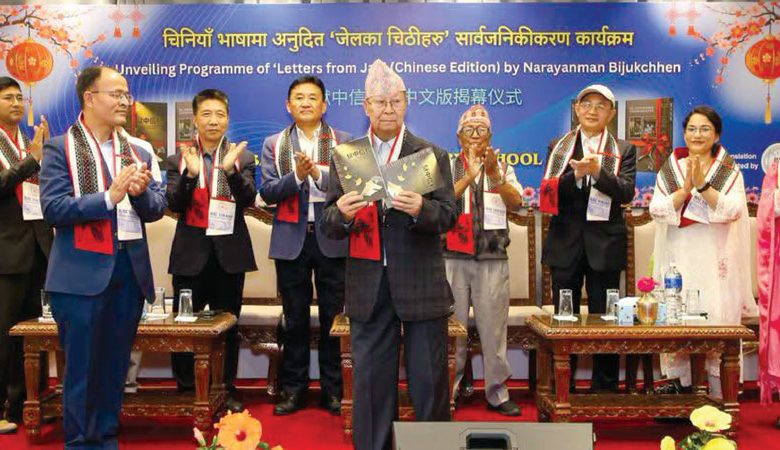
In an event organised by Bal Bikas English Secondary School with the support of the Confucius Institute at Kathmandu University (KU) in Liwali, Bhaktapur, the Chinese translation edition was jointly unveiled by writer ‘Rohit’ himself along with other distinguished literary figures on Saturday evening.
Publisher Bal Bikash English Secondary School, Bhaktapur, claimed that the publication aims to introduce Chinese readers to Bijukchhe’s political philosophy, life experiences, and contributions to Nepali literature, while further strengthening cultural exchange and mutual understanding between Nepal and China. Chairman of Nepal Workers and Peasants’ Party, Bijukchhe is a former parliament member and Constituent Assembly member.
The book contains 25 letters Bijukchhe had written to his wife Shova Pradhan from Nakhu jail during the Panchayat era in 1988-1989.
“The Panchayat System tried to suppress the people’s political movements and often created conspiracy against political leaders and activists. Meanwhile, Rohit and dozens of innocent cadres of then Nepal Workers and Peasants’ Organisation were sent to jail owing to state-hatched conspiracy and unfair trial,” the publisher, Bal Bikash Secondary School, has written in the preface of the book. “The aim of the then Panchayat government was to oppress and eliminate Nepal Workers and Peasants’ Party and halt the rising communist movement during its infancy.”
A primary level teacher, Pradhan was pregnant then and had only a four-year-old son, Subeg and an old-age mother-in-law. Her brothers-in-law and many activists of the Party were compelled to go underground.
The police, with their heavy boots pounding and baton-charging, broke through her front door. They came to her home repeatedly to threaten and confiscate books and belongings, without keeping the records in the presence of locals or the civil witnesses. During that time, she was totally helpless and extremely terrified to face the situation.
In that critical time, Bijukchhe wrote those letters to her, just to make her not lose hope and patience. Through the letters, he wanted to inspire, sympathise, guide and inform her about the political toughness during the difficult days. In the letters, he had written about his involvement in the communist movement, literature and intellectual activities
Speaking at the function, author Bijukchhen recalled the difficult days he spent in prison and reflected on the political circumstances of that period. “I feel proud and satisfied to have my book now translated into Chinese and made accessible to Chinese readers,” he said.
The event featured reflections from Surendra Raj Gosai, Member of the Bagmati Provincial Assembly; Professor Taralal Shrestha of the Central Department of English at Tribhuvan University; Dr. Sarbottam Shrestha, former President of the Arniko Society and a researcher of Chinese culture; and Professor Li Shuangcheng, Director of the Confucius Institute at Kathmandu University. They highlighted the book’s ideological significance and literary value.
Also addressing the gathering were Gu Zhichao, Editor-in-Chief of China Culture Network; Liu Dihong, representative writer of Meishan Literature at Shanghai University; and the translators, Zhang Hongwei and Pranaya Chitrakar, who shared their experiences of translating the book and discussed how the publication would further contribute to cultural ties and friendship between Nepal and China.
The Rising Nepal