TheRisingNepal
Binu Shrestha
Kathmandu, Sept. 15: On the last day of Indra Jatra, the Living Goddess Kumari was taken out for a procession in the core city areas along with Ganesh and Bhairav.
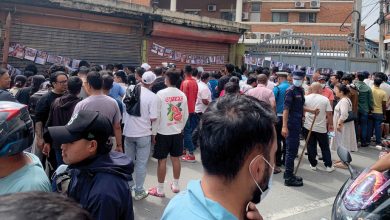
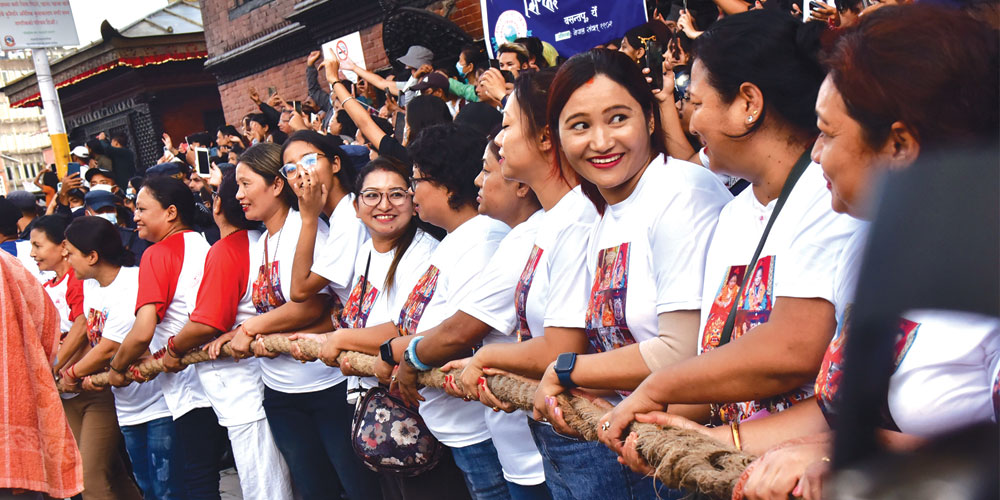
The onlookers were excited when all women donned in white T-shirts pulled the chariots of the Living Goddess and Gods of the Kathmandu Valley
Every window and balcony of the buildings of the core city areas was occupied by men and women with curious eyes to watch the chariots pulled by women, which is called as Nanichya Rath Yatra.
In the past, women were not allowed to touch the chariots but this tradition ended in 2012 when women were allowed to pull the chariots.
“It feels excited to get an opportunity to pull this chariot,” said Manju Maharjan of Sitapaila, who has been pulling the chariot during Intra Jatra for five years. “Nanichya Rath takes place once a year so I never miss this opportunity,” she added.
“I got opportunity to pull all three chariots of Kumari, Ganesh and Bhairav earlier. This year I pulled Ganesh chariot,” Maharjan said.
“I am feeling happy to take part in this magnificent chariot pulling procession,” said Gyanu Maharjan, who was pulling the chariot for the first time on Wednesday. Hundreds of women regardless of their age flocked to Basantapur to try their hands at the chariot.
The Nanichya Rath Yatra began after Deputy Mayor of Kathmandu Metropolitan City Sunita Dangol pulled the three chariots one by one.
Gautam Shakya, president of Indra Jatra Management Committee, said that local women demanded their equal participation in chariot procession of Indra Jatra like in Red Machhindranath chariot procession of Patan.
“We discussed with concerned trusties, committee members and elder citizens about the demand of women. After discussions, it was decided to allow women to pull the chariots on the third day of chariot procession respecting women’s demand,” Shakya added.
In 2011, for the first time, the women pulled the chariot of Kumari but they were not allowed to pull two other chariots – Ganesh and Bhairav. It was their trial period so only single chariot was allowed first, he said.
After seeing discipline, dedication and proper management of women in chariot pulling time, they were allowed to pull all three chariots in 2012. Since 2012, the chariots are pulled by all-women devotees.
For last nine years, the chariots are being pulled by women in a systematic way. It was not organised in first phase lockdown due to the COVID-19 pandemic. This year is 10th year of women participation. All those willing to pull the chariots cannot take part in chariot pulling directly.
See Page 6
They need to register their name to take part in the pulling process. Nani Hera Rath Yatra Committee registers the name of those women willing to take part in chariot pulling.
Sajani Maharjan, member of Nani Hera Rath Yatra Committee, said that 500 women were actively involved in pulling the three chariots. Of them, 300 women pulled the Kumari chariot and 100 each pulled the chariots of Ganesh and Bhairav respectively. To recognise the registered women, Indra Jatra Management Committee distributed T-shirts to them.
It is said that the last day of chariot procession was introduced by Malla King Jaya Prakash Malla.
On this day, the chariot procession starts from Basantapur and then moves to Pyaphal-Yetkha-Naradevi-Kilagal-Bhedasing-Indra Chowk-Makhan and back to Basantapur.
This route has significance because it is said that it had been fixed to let the King’s girlfriend named Nanichya see the jatra from the comfort of her own home in Kilagal.
Since then, the third-day chariot procession is known as Nanichya Rath Yatra.
As the custom for centuries, President Bidya Devi Bhandari visited Kumari Ghar Wednesday night to receive tika from the hands of Kumari. The head of the state graces Indra Jatra twice.
On the main day, President Bhandari observed Indra Jatra from the balcony of the Gaddi Baithak on Friday and received tika and Prasad. But, today she visited Kumari Ghar to receive tika from the hand of Kumari and offered gold coin to her.
The eight-day-long religious festival ended on Wednesday after pulling down the wooden pole at 7.33 PM and immersing it at the confluence of Teku Dovan.