Economy assumes the optimal use of resources for production, distribution, circulation, exchange, and investment. It creates essential public goods, equally shared by all people, to improve the quality of life. Peace, like justice and freedom, has been a highly prized value since the dawn of human civilisation. Aspiration, pride and envy of human beings, however, go beyond physical survival. Progress requires cooperation with others on mutually beneficial grounds. Scarcity of survival causes the predation of natural resources and the property of others. Politics of greed, grievance and loot stokes conflict and hinders economic growth and social peace. The use of technology in production has reduced the burden to human labour and satisfied basic needs, while surplus products have necessitated the need for trade and commerce.
Use of technology in offense has generated a cycle of insecurity and accumulation of weapons where politics manipulated the rewarding works of people, leaving them teetering on the edge of anguish. A peace economy needs cooperation, compassion and kindness toward each other. Noted economist John Maynard Keynes argued that sustainable peace can be achieved not by the absence of war but by the alleviation of misery, deprivation and social despair. His vision of an economy is rooted in economic stability, shared prosperity and mutual cooperation at the community, society and nation-state levels. He believes in the fair distribution of resources in society so that no one is left hungry. Equity-based welfare can bridge wealth gaps in society, stifles extremism and cherishes inclusive progress in consonance with nature’s potential for renewal.
Moral science
Treating the economy as a moral science, not just the value-free science of wealth creation, Kenneth Boulding deems empathy and compassion for human behaviour. This notion frames the cornerstone of peace economy or peace dividends, a concept based on the civilian pursuits of greater prosperity of people. Gautam Buddha, Boulding and Joseph Schumpeter advocated a need-based economy, not greed-based or colonisation of nature, where even women’s care work for children and the elderly is counted as economic activity. The state is enabled to stand for society, not alienation from its social responsibility. But deforestation has negative effects on the fertility of native soil, causing landslides, biodiversity loss and human-animal conflict, thus increasing the size of climate-induced migration. Only the circular economy that cuts waste and maximises resource use bears the potential for greening the nation and sustaining durable peace.
Likewise, the economy of peace aims to reduce the sources of violent conflict, promote long-term social cohesion and a shift of resources from violence-producing structures, action and political culture to productive, equitable and ecologically sustainable activities. It is absurd to release risks, scarcity and predation of others’ property unlawfully in the name of human rights, democracy, class, ethnicity, regionalism or patriarchy as they breed the sources of manifest violence and generate a state of nature, not civic virtues vital for a cooperative life. This is why democratic states formulate policies to manage public resources, impose reasonable taxes and create laws for social security and social protection to subsidise the needy and create a peaceful public order. The constitution has adopted common aspirations, values, rights and institutions for the unity of people, enabling them to exercise freedom, livelihood rights and forge social solidarity with the state, cooperative and private sectors for national prosperity.
The economic self-reliance advocated by the Nepal government draws its legacy from Prithvi Narayan Shah’s focus on local entrepreneurialism, trade, economic mercantilism and national wealth. It has adopted economic laws for the prevention of exploitation and bribery. He deemed corruption a national offense and sought ethical business. The monopoly of wealth in a few does not stabilise the economic system. It resists economic and social change. Nepal’s welfare state, therefore, presumes the rationalisation of the government’s role in the economy to mediate class interests so that economic extremism, policy and institutional capture are forbidden. To be sure, it is the institutions that shape incentives for economic progress. For the public administration, anti-graft laws and institutions are set up to control the rent-seeking and stealing of public property. The rent-seeking practice has deprived the Nepalis of the public goods and puts the nation on the grey list.
Public wealth
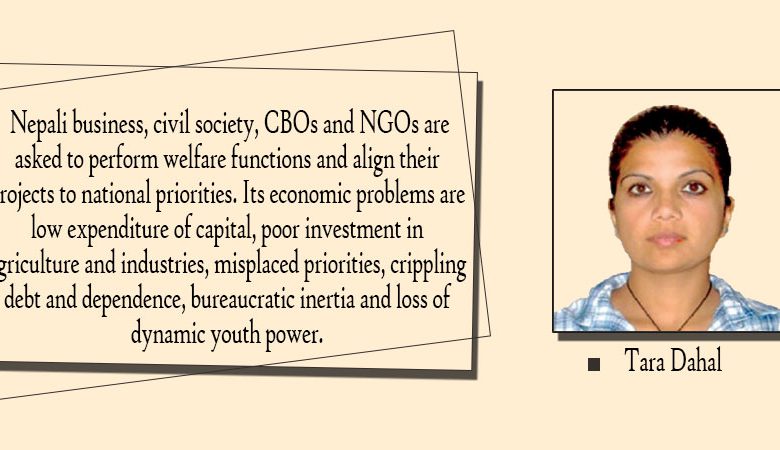
Private vices of greed and profits in no way create public wealth. When private capital is freed from social investment and allowed to siphon off profits to foreign nations, it does not meet public demands for adequate services. Nepali business, civil society, CBOs and NGOs are asked to perform welfare functions and align their projects to national priorities. Its economic problems are low expenditure of capital, poor investment in agriculture and industries, misplaced priorities, crippling debt and dependence, bureaucratic inertia and loss of dynamic youth power. Nepali politics has yet to balance the provision of private property to public welfare for the poor and create a condition of social justice and peace. The lingering transitional justice testifies that leaders in the past preferred power-sharing over justice and positive peace.
In a bid to survive, Nepali people’s response has been to migrate abroad, engage in the informal sector, cooperatives, small-scale business, wood crafting, animal husbandry, natural farming, wage earning and sometimes pooling their resources for livelihood projects. They focus not only on markets but also on fulfilling basic needs. Famous peace researcher Johan Galtung deems peace economy a living economy founded on “meeting basic human needs (survival, welfare, identity and freedom), ensuring ecological sustainability and fostering equitable symbiosis between communities.” One might call this economy of care and justice where no one is left out, not even the weakest members of society, the poor, homeless and landless. It stresses the production of things not for the market value but for survival, service and livelihood. Social efficiency of Nepalis in the public and private life creates virtuous conditions for cooperation and contributes to the economy of a resilient edifice of peace.The Rising Nepal
(Tara Dahal holds an MA in Peace and Conflict from Otto-Von Guericke University, Germany)