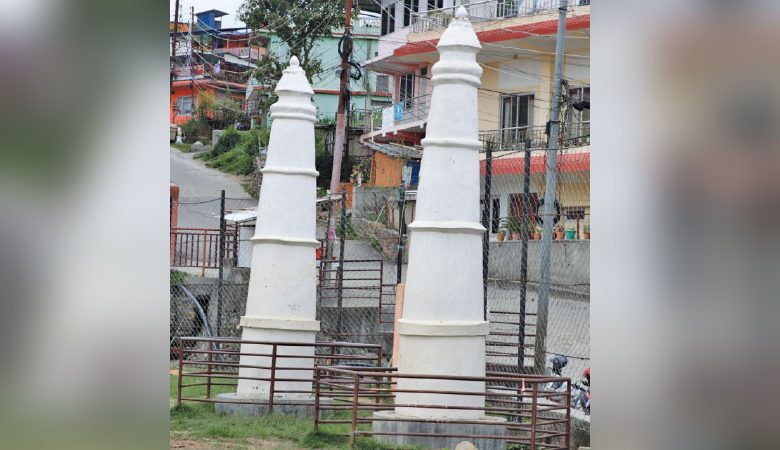
The Jor Dharahara standing at Tudikhel in Dhankuta.
By Kabiraj Ghimire, Hile, July 8: When Nepalis hear the word Dharahara, most immediately think of the iconic tower at Sundhara in Kathmandu. However, the historic hill town of Dhankuta in eastern Nepal is also home to two century-old towers. Situated at the north-eastern corner of the Lower Tudikhel in Dhankuta Municipality-5, the two white towers are locally known as the Jor Dharahara (Twin Towers).
Standing beside the Tudikhel, which remains bustling throughout the year with sporting events, public gatherings, fairs and festivals, these towers have silently witnessed Dhankuta’s history for over a century.
Around 10 feet tall and resembling miniature versions of the famous Dharahara, they may appear ordinary at first glance, yet they embody a rich historical legacy. Ironically, despite their significance, there is still no definitive answer as to who built them, when they were constructed, or for what purpose.
Local elderly resident Shreekrishna Shrestha says the Jor Dharahara have long been familiar landmark for the older generation in Dhankuta.
Like Shrestha, many senior citizens regard the Jor Dharahara as silent witness to their childhood and youth. For more than a century, the structures have stood through every major event in Dhankuta’s history.
Yet the questions of who built them and why remain unanswered. Constructed in the style of the traditional Dharahara, each tower features nine distinct tiers and was built using bricks and mud, the construction materials commonly used at the time.
No written records have been found identifying the builders or the exact period of construction. Nevertheless, several theories continue to circulate.
Historian Tek Bahadur Shrestha believes the towers may have been constructed around the time when the Dhankuta Gauda (administrative headquarters) was established.
In Kathmandu, the original Dharahara was used by soldiers to observe military movements and to sound bugles during emergencies. Although the Dhankuta Dharaharas were not tall enough to serve as observation towers, Shrestha believes they may have been built symbolically, with nearby open space serving military purposes.
“Kathmandu once had two Dharaharas. The Jor Dharahara in Dhankuta may have been built as a replica of those structures,” he said.
Historian Dr. Gopal Bhattarai, an authority on the history of Dhankuta, believes the towers were built between 1985 and 1989 by the then Bada Hakim (chief administrator) Hiranya Shamsher.
According to him, the Tudikhel, originally established in 1883 BS, was upgraded during Hiranya Shamsher’s tenure, and the towers were likely added as part of that improvement.
Another researcher and author, Thakur Baral, attributes the construction to Bom Bikram Rana, who served as Bada Hakim of Dhankuta. After being exiled to Chittorgarh in India following the political upheaval of 1938 BS, Bom Bikram Rana was reportedly recalled to Nepal by Bir Shamsher in 1942 BS and appointed chief administrator of Dhankuta.
Baral believes he oversaw the construction of several public structures, including the Jor Dharahara.
“During his tenure in Dhankuta from 1942 BS to 1960 BS, he built the Jor Dharahara, improved the Tudikhel, constructed carriage roads in the bazaar, and developed several other public structures,” Baral said.
Researcher and author Gopal Bhandari offers yet another theory. He suggests the towers may have been built around 1900 BS by Bahadur Singh Bhandari, who was the grandson of Nayan Singh Thapa, the brother of Bhimsen Thapa.
According to him, Bahadur Singh sought to replicate the architectural style of Kathmandu after arriving in Dhankuta.
A popular local legend also claims that Dev Shamsher ordered the construction, declaring, “One Dharahara rules Kathmandu; I shall rule Dhankuta with two.”
However, historians, including Baral, Bhandari, and Bhattarai, dismiss this version. They argue that Dev Shamsher, after being removed from power, stayed in Dhankuta for only about three months before departing for India, leaving him little opportunity to undertake such construction.
Despite their historical significance, the Jor Dharahara have yet to be officially listed by Nepal’s Department of Archaeology.
According to Sandip Khanal, Chief Archaeology Officer and spokesperson for the Department, the structures have not been enlisted because no formal initiative has been taken to document or propose them for inclusion.
He said the Department now plans to restore the towers to their original condition before formally listing them as protected heritage monuments.
While Kathmandu’s Dharahara towers have repeatedly collapsed in earthquakes and been rebuilt over the years, with the Sundhara Dharahara reconstructed and the Bag Durbar Dharahara limited to the history, the Jor Dharahara of Dhankuta have stood steadfast for more than a century.
The Rising Nepal