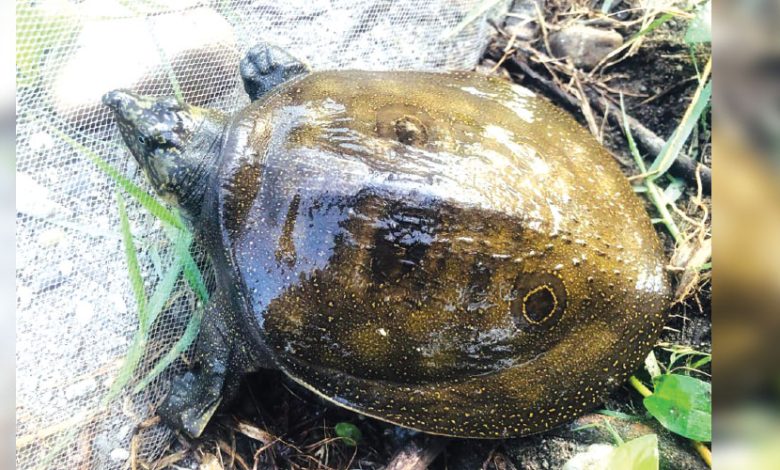
By Baburam Karki,Barahakshetra, Sept. 29: Turtles, once commonly seen in rivers, ponds, lakes, wetlands and streams in the Chure region of the Tarai, are becoming increasingly rare. Conservationists say their numbers are declining as their habitats are gradually being destroyed due to human activities.
Encroachment on water sources and wetlands, habitat fragmentation, illegal hunting and collection, turtles getting caught in fishing nets, the use of poison and electric current for fishing, road construction and water pollution are narrowing turtle habitats, according to conservationists.
Although 18 turtle species have been recorded in Nepal, 12 of them are listed under threatened categories by the International Union for Conservation of Nature (IUCN).
Asmit Subba, a researcher pursuing a PhD on turtles and reptiles at the Chinese Academy of Sciences, said turtle conservation should not be understood merely as an effort to save a single species.
According to him, effective turtle conservation is possible only by protecting the water bodies where turtles live, riverbanks, sandy or muddy areas where they lay eggs, basking sites, food sources and surrounding vegetation.
“Protecting turtles does not mean saving only one species; it means protecting the water, land and vegetation associated with their habitat,” he said.
Turtles, which belong to the reptile class, require not only water but also safe riverbanks, sandy or muddy areas for laying eggs, basking sites, food and natural vegetation.
Although some species spend most of their time in water, they depend on safe areas along riverbanks during the breeding season.
Researcher Subba said the filling of wetlands, destruction of natural ponds and water bodies, haphazard construction along riverbanks and the removal of surrounding vegetation directly affect the life cycle of turtles.
Conservationists say turtle conservation should therefore be linked with wetland conservation, as wetlands store rainwater, recharge groundwater, reduce the impact of floods and provide habitats for various animals and plants.
Softshell turtles at risk
Some species of softshell turtles found in eastern Nepal are facing increased risks due to human activities. Such turtles, which depend on deep rivers, water bodies and wetlands, are increasingly threatened by habitat encroachment, illegal hunting, use of turtle meat and traditional practices, as well as illegal trade.
Conservationists say fishing with poison or electric current in rivers and wetlands in Sunsari, Morang, Jhapa and Saptari affects turtles and other aquatic animals.
Turtles caught in fishing nets and hooks are also at high risk of being injured, suffocating or dying.
The natural habitats of turtles are becoming fragmented due to the expansion of roads, settlements, agriculture, industries and other infrastructure. Researcher Subba said the division of large habitats into smaller areas makes it difficult for turtles to find food, reproduce and reach safe locations.
Conservationists say turtles are also increasingly being hit by vehicles while crossing roads when roads divide their habitats.
As turtles grow slowly and take a long time to reach adulthood, researcher Subba said it takes a long time for their populations to recover once their numbers decline.
The Charkose Jhadi forest belt in the eastern Tarai has also become fragmented in several areas in recent years due to settlement expansion, agriculture, roads and other infrastructure.
Conservationists say changes in ponds, streams, riverbanks and wetlands connected to forests also affect aquatic animals and wildlife dependent on these habitats.
Researcher Subba said priority should be given to maintaining deep water, minimising human interference and protecting natural riverbanks in areas where turtles are found.
He suggested expanding conservation programmes to other potential rivers and wetlands in addition to the Koshi Tappu area.
Community participation needed
Conservationists say local communities have an important role to play in turtle conservation. Professor Dr. Kalu Ram Khumbu, who obtained Nepal’s first PhD in herpetology from Tribhuvan University in 2005, said turtle conservation should not be limited to saving a single species but should be pursued as an effort to protect the overall habitats of reptiles and amphibians.
He said research, data collection and regular studies of habitats were necessary for this purpose.
Professor Khumbu said different turtle species feed on vegetation, insects, fish and other organic matter and therefore play a role in the food chain.
The Rising Nepal