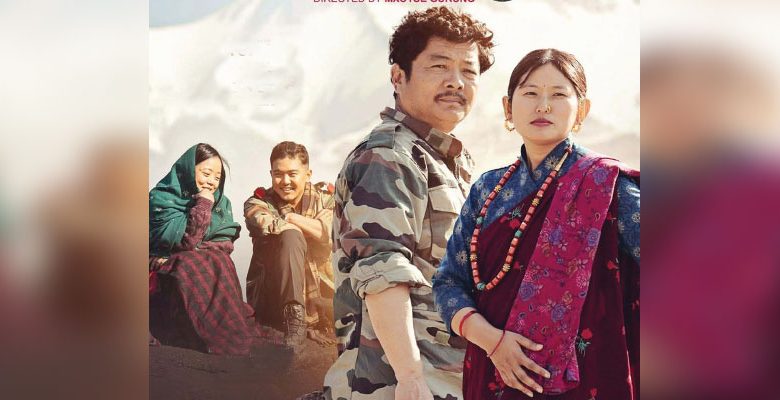
By Santosh Subedi, Kaski, Sept. 17: ‘Pension Patta’ is a film about the ups and downs that arise in the search for a solution to an error in the name recorded on the pension document following the death of a former Indian Army soldier.
‘Pension Patta’ is not merely the story of a Lahure (foreign army soldier), but also attempts to portray the different problems faced by the children of Lahure families and their social surroundings.
With historical context, the film depicts the uncertain future of a Lahure who has gone to fight in a war and the mental stress experienced by the wife or family waiting for him at home.
Overall, ‘Pension Patta’ is not simply the story of a former Lahure. It is also the story of those who spend their entire lives struggling with the loss of love and living with its memories.
After the death of former Indian Army soldier Gangabahadur, his younger wife Chhalmaya and son Rajan (Dayahang) reach the pension camp in Pokhara, where a mystery emerges: instead of Chhalmaya’s name, someone else’s name appears in the record file.
The film’s main conflict and journey begin here: whose name is recorded on the pension document? Rajan sets out on a journey to find his father’s first wife in order to claim the pension. What happens during this journey? What kinds of problems does he encounter? These are the questions around which the story of the film revolves.
The central theme of the film is based on the administrative and documentation problems faced by Lahure families.
The film incorporates the complications created in the past when Lahures married in their villages and took another wife elsewhere, as well as family breakdown and the problems of polygamy.
It highlights the harsh economic hardship a family can face when its main breadwinner dies, and the pension is held up, as well as the legal battles between the children of the first and second wives caused by unclear documentation left behind by their father.
The film has also not forgotten Gurung culture. As director Maotse Gurung is himself closely connected with this culture, he has incorporated cultural aspects of the Gurung community, including the tradition of tying a thread, marriage between a maternal uncle’s daughter and a man, and Rodhi.
The film shows scenes of Rodhi culture, where people sing and dance when a Lahure returns or when young men and women gather in the village.
It also depicts cultural traditions such as blocking someone’s path with a shawl during courtship and the ritual of tying a thread as a symbol of establishing a relationship.
The most interesting aspect of the film is that the story is extremely simple.
The director’s presentation of this simple story makes the film strong. A major social reality is portrayed through small events from everyday life. This is where the film’s beauty lies.
Dayahang Rai’s performance as Gangabahadur’s son is one of the film’s major attractions.
Gaumaya Gurung, who plays Mala, gives a graceful and understated performance. Wilson Bikram Rai, in the role of the eastern Nepali driver Lunga, does justice to his character. The characterisation of actors such as Pashupati Rai, who plays the first wife, Buddhi Tamang, the late Sunil Thapa, Pushkar Gurung, Suraj Gurung, Manoj Gurung and Pratiksha Gurung gives the film completeness.
The music is one of the film’s well-liked aspects. When the song ‘Juni Jala’ appears on screen, a distinct sense of excitement can be seen among the audience. Although the film captures the rural setting and natural beauty of places such as Tangting in Kaski, some scenes appear pale and blurred.
Cinematically, the film falls short of being outstanding. Minor technical errors in lip-sync can also be noticed in some scenes. Despite some limitations and weaknesses in the technical aspects, the film serves as a window through which the younger generation can understand the indigenous culture that it is gradually forgetting.
The Rising Nepal