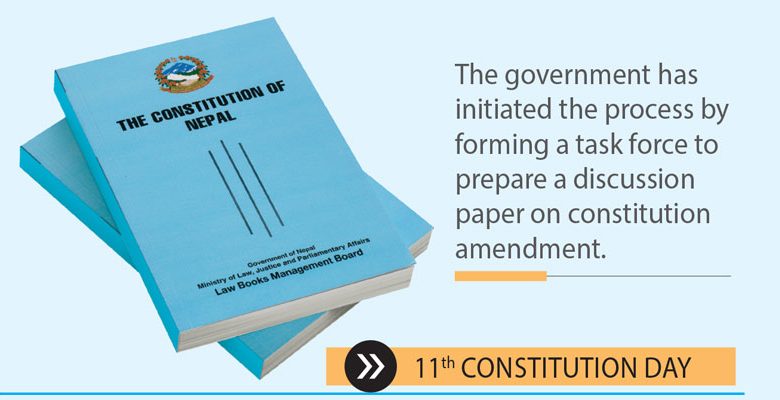
By Shambhu Dangal, Kathmandu, Sept. 19: As the nation marks the 11th Constitution Day after completing a decade since the promulgation of the constitution, a debate has gained momentum over reviewing and amending some of its provisions to make them responsive to changing circumstances.
The government has initiated the process by forming a task force to prepare a discussion paper on constitutional amendment, with the stated objective of addressing the demands raised by the Gen Z movement and broader calls for reform.
The taskforce, led by Prime Minister’s Political Adviser Asim Shah, was given 90 days to collect suggestions and work towards building national consensus on constitutional amendment. It has already submitted its report after consulting 184 experts, including representatives of political parties, constitutional and legal experts, former judges, civil society and the private sector.
According to task force member and lawmaker Mohan Lal Acharya, 44,613 digital suggestions were also collected during the consultation process.
Senior Advocate Radheshyam Adhikari said a review of the constitution was necessary as it provides for amendment in itself and a decade had passed since its promulgation. He, however, stressed on political consensus for the task.
“Even when amending ordinary legislation, we seek broad consensus. Constitutional amendment is more complex and therefore requires political consensus first,” he said.
Adhikari suggested that provisions on which national consensus can be reached should be amended accordingly, while a mechanism comprising representatives of political parties and civil society could be formed to hold broader discussions on constitutional review.
Similarly, House of Representatives member Yagya Mani Neupane said constitutional reform was necessary, including a comprehensive review of the system of governance.
“There is a need for extensive discussion and reform to make the provinces more efficient under the federal system. Constitutional commissions and the restructuring of the judiciary, among other issues, also require comprehensive review,” he said.
Lawmaker and Rastriya Swatantra Party Spokesperson Jagdish Kharel said the debate on constitutional amendment should be intensified and brought to a logical conclusion.
“We have already incorporated the issue of constitutional amendment in our party manifesto and political positions. The party believes that the debate is relevant. There is a Nepali saying that a river changes its course in 12 years. We should build on the constitution’s strengths while amending provisions that have proved inadequate,” Kharel said. He said the Prime Minister had formed the task force in line with the party’s policy to advance the debate and prepare a discussion paper on constitutional amendment.
Former Attorney General Raman Shrestha, however, noted problems in implementation had also stemmed from deviations among the political parties that had originally drafted the constitution. He questioned whether the constitution had been properly implemented by the executive and judiciary, particularly during the dissolution of the House of Representatives on two occasions. He said state institutions had sometimes exploited loopholes in the constitution, underscoring the need to rectify such weaknesses.
Another former Attorney General Ramesh Badal said the government should clearly spell out the purpose and scope of any proposed amendment. “There must be national consensus on whether the proposed changes concern the system of governance, electoral system, or the division of powers among the federal, provincial and local levels,” he said. Janata Samajwadi Party Nepal executive member Manish Suman said the current constitution was progressive compared with the country’s previous seven constitutions but still contained significant shortcomings requiring correction. He argued that amendment was necessary to make the constitution a document shared and owned by all sections of society.
Former Constituent Assembly member Shashi Shrestha recalled that there had been an understanding at the time of promulgation to protect the constitution while subsequently correcting inadequate provisions and shortcomings.
She said constitutional reform should strengthen the rights of women, Dalits, indigenous nationalities, marginalised regions and communities, minorities and other disadvantaged groups, while addressing inconsistencies identified during implementation.
However, Shrestha cautioned that amendments should not curtail existing rights or deprive citizens of rights already guaranteed by the constitution.
The Rising Nepal