Photo: AI
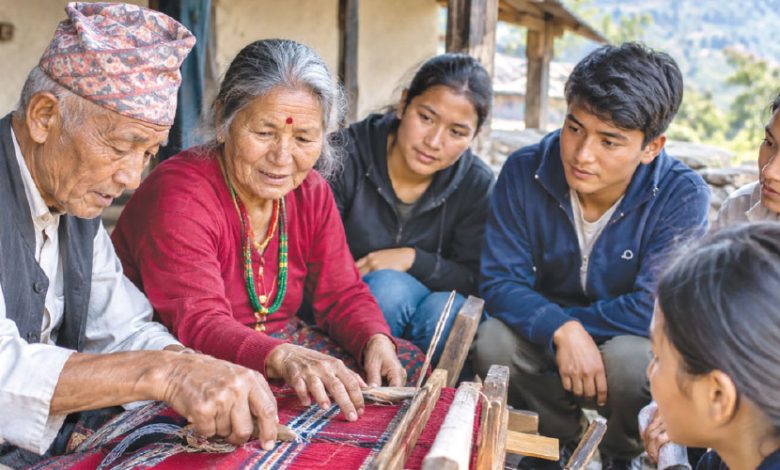
By A Staff Reporter, Kathmandu, Oct.2: The Ministry of Women, Children, Senior Citizens and Social Security has announced to establish a ‘Senior Citizens’ Experience Bank’ to preserve the knowledge, skills, life experiences of senior citizens and transfer them to younger generations.
The Ministry announced the initiative on the occasion of the 36th International Day of Older Persons, saying senior citizens should not be viewed only as a group requiring care and protection, but also as a valuable source of knowledge, skills and experience.
The initiative will use digital technology to document the experiences and knowledge accumulated by senior citizens throughout their lives and make them accessible to students, young people and future generations, the Ministry informed.
The initiative aims to ensure that the knowledge and experiences accumulated by senior citizens through decades of practice and life journeys do not disappear with them, but are preserved and made useful for future generations.
Minister for Women, Children, Gender and Sexual Minorities and Social Security Sita Badi said the knowledge, skills, experiences and life experiences of senior citizens were valuable intellectual and social assets of the nation.
“The knowledge, skills, experiences and life lessons accumulated by senior citizens are valuable intellectual and social assets of the nation. To institutionalise the preservation, documentation and transfer of these experiences across generations, the process of establishing and developing a ‘Senior Citizens’ Experience Bank’ using digital technology has been initiated,” said Minister Badi.
According to her, the initiative will help transform the knowledge and experience acquired by one generation into guidance for the next, thereby strengthening intergenerational knowledge transfer. The ministry plans to institutionalise the documentation and transfer of experiences acquired by senior citizens throughout their lives in areas such as agriculture, entrepreneurship, profession, education, administration, arts and culture, traditional knowledge, social life and various practical fields, using digital technology. According to the Ministry, the intergenerational knowledge transfer will be the main foundation of the experience bank.
The concept is to gradually develop the bank into a platform where students, young people and new generations can learn from and receive guidance based on the knowledge, experiences and life lessons of senior citizens free of charge.
The Ministry’s concept aims to establish senior citizens not merely as beneficiaries receiving services and facilities from the state, but also as knowledge providers who can share skills, transfer experiences and guide younger generations.
Minister Badi said genuine respect for senior citizens would be established when their experiences were heard, their knowledge was used with due
respect, and an environment was created for their meaningful participation in social and decision-making processes.
She said changing family structures, migration, urbanisation and changing lifestyles had brought new challenges related to the health, social security, care, loneliness and social participation of senior citizens.
Ensuring that their lives remain safe, dignified and meaningful is a shared responsibility of families, communities, society and the state, she said.
Talking to The Rising Nepal, Chakra Bahadur Buda, Joint-Secretary of the Ministry, said the primary goal of this proposed project is to digitally
archive the valuable experiences, knowledge, and expertise of elderly individuals so that their wisdom can be passed down to younger generations.
There is also a concept of facilitating interaction between grandparents and grandchildren, or between older and younger generations, so that they can discuss, share and exchange their experiences, he added.
He however, clarifies that the exact implementation modality has not yet been finalised.
According to him, the Ministry plans to consult with relevant stakeholders and federations to determine the best
approach, whether through audio, video, or interactive platforms, before officially launching the project.
Applauding the government’s plan, former Chief Election Commissioner Neelkantha Upreti said the initiative could safeguard the invaluable intellectual property, life histories and specialised knowledge of elderly individuals before it is lost.
“This initiative appears to preserve historical memories for future research and analysis. Capturing such unrecorded wisdom is a positive and worthwhile endeavour,” he claimed.
The Rising Nepal