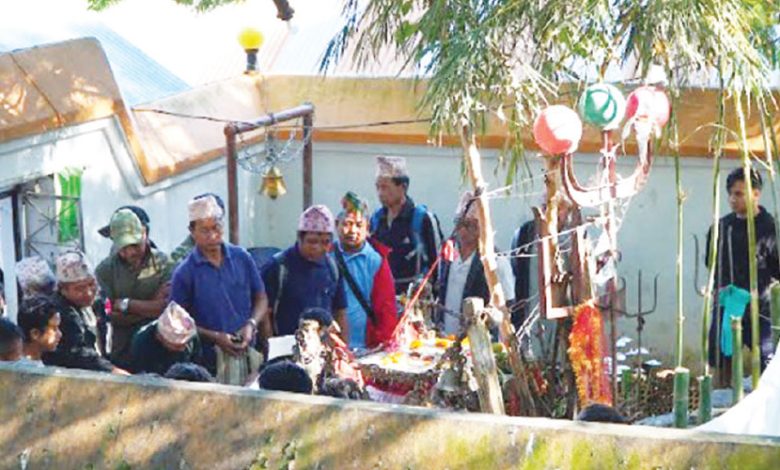
Photo: Santosh Subedi A Margathan (ritual site) where the Athpahariya people of Dhankuta perform worship.
By Santosh Subedi, Dhankuta, Oct. 2: The Athpahariya community of Dhankuta has begun celebrating Nawagi, one of its major traditional festivals. The community, which considers the area between the Arun and Tamor rivers in eastern Nepal its ancestral homeland, observes the festival through a series of religious and cultural rituals.
The Athpahariya people have their own distinctive language, customs, culture and traditions. Traditionally, Nawagi is celebrated for several days following the full moon of the Nepali month of Bhadra. Community members perform various rituals to express gratitude to their ancestors and deities and to seek blessings for agricultural prosperity.
According to community leaders, the festival begins with the cleaning of the sacred Margasthan area (ritual site). On the second day, a ritual involving young chickens is performed, followed by the offering of a buffalo on the third day. On the fourth day, the offerings are taken to the sacred site and ancestral worship is performed. The fifth day is marked by a community feast, while the final day is traditionally observed as the festival’s concluding ceremony.
Agriculture is closely connected with the festival. The Athpahariya community believes that their ancestors and deities bless them with rain in the spring, helping them plant crops, while rainfall during Bhadra or Asoj helps the crops mature. After the harvest, new grain is first offered to the clan deities and ancestors before being consumed by the family.
The Athpahariya community celebrates three major festivals in particular: Nawagi in Bhadra, Visu in Baisakh and another Wadangmet celebration in Mangsir. Among these, the Mangsir festival is considered especially important.
According to the 2021 national census, 5,878 Athpahariya people live in Dhankuta Municipality. The community includes 19 different ethnic groups, including Chhara, Humbara, Kimdahang, Lengsuwa and Pangsu, according to community representatives.
Although many young people have moved to different parts of Nepal and abroad for employment and education, they continue to return to Dhankuta to celebrate traditional festivals and perform ancestral rituals. Community members say preserving their language, culture and traditions has become increasingly important as cultural practices face challenges from social change and migration.
TRN Online