By Toplal Aryal, Resunga, Oct. 11: Special Dashain worship will begin on Sunday with Ghatasthapana at historic forts and various Shakti Peeths (sacred Hindu pilgrimage shrines dedicated to goddesses) in Gulmi district.
Traditional rituals are being performed at forts in Isma, Musikot, Dhurkot, Chandrakot and Charpala, which were part of the former Baiese-Chaubise principalities, as well as at Shakti Peeths in Ghamir, Arje, Resunga, Marbhung, Arkhabang, Wami and Chhatrakot, among other places.
There is a tradition of priests and religious scholars observing fasts and performing daily worship throughout the 10-day Dashain festival, beginning on Ghatasthapana.
The rituals of bringing in Phulpati, organising special worship and fairs on Maha Nawami, applying tika on Bijayadashami and performing the traditional Saraya dance make Dashain in the district distinctive. According to Padam Bahadur Singh, chairman of the Musikot fort management committee, the fort has a tradition of appointing two priests from the Thakuri and Saru communities and religious scholars from the Pangeni and Ghimire communities.
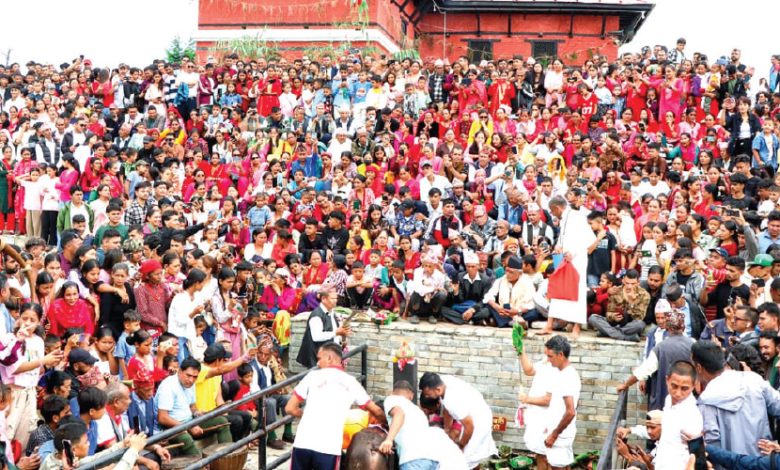
On Saptami (seventh day), Phulpati is brought from Beltari in Kurgha in the mandatory presence of members of the Thapa community. Accompanied by traditional musical instruments, the sacred offerings are carried in a palanquin and taken into the fort. Special worship, including animal sacrifice, and a fair are organised on Nawami, while tika and Saraya are observed on Dashami.
At Isma Kot, the tradition is for a Brahmin community, from the Aryal family to serve as the chief religious scholar and a member of the Khadka community to serve as the priest. Seven people, including an assistant religious scholar, perform daily worship for 10 days.
Phulpati, along with bel leaves, is brought from Ratamata in Rajsthal and taken through Isma Maidan to the fort, accompanied by traditional musical instruments, before being installed as part of the worship of Khadga Bhagwan.
A special fair is held on Nawami. On Dashami (10th day), worship concludes after Khadga Bhagwan is taken to the temple on the ground.
Playing Patta, a traditional martial performance, and singing Malshree, a traditional devotional song associated with Dashain, were also customary in Isma on Phulpati day.
However, these cultural practices are at risk of disappearing because of migration and the failure to pass them on to younger generations, local resident Hari Pangeni said.
Khagaraj Basnet, chairman of the Isma Kot Manakamana Worship Committee, also said that cultural traditions associated with Dashain were gradually disappearing because they were not being passed on to the younger generation.
At Dhurkot Fort religious scholars from the Pokhrel community and priests from the Khadka, Thapa, Karki and Ghartichhetri communities observe fasts and perform the rituals.
According to Krishna Prasad Bhandari, principal of Himalaya Secondary School, of Dhurkot Rural Municipality-5, Phulpati is brought from Batule in Jaishithok on Saptami and taken into the fort in the evening amid traditional music. A special fair is held on Nawami.
At the Ishwari Devi Temple in Charpala, Gulmidurbar, a member of the Aryal community serves as the chief religious scholar, while a member of the Thakuri community serves as the priest.
According to Homnath Aryal, chief religious scholar at the Ishwari Devi Temple of Gulmidarbar Rural Municipality-6, representatives of 11 communities, including Majhi, Mahat and Mahatara, have a tradition of covering or ritually concealing 11 deities during Dashain.
Phulpati is brought from near Khajyang on Saptami, while special worship is performed on Ashtami and Nawami.
At the Khadga Temple in Chandrakot, religious scholars from the Neupane, Gautam and Paudel communities and priests from the Thapa, Fauzdar and Lamtari communities perform the rituals.
Phulpati is brought from Jitare Danda in Rupakot on Saptami. Special worship, including animal sacrifice, takes place on Nawami.
On Dashami, akshata (sacred coloured rice grains) is offered at the temple pillar before tika is applied. Saraya is
traditionally performed on the full-moon day.
Tej Bahadur Thapa, acting chairman of the Khadga Temple Management Committee, said local people established the temple after the unification of the Baiese-Chaubise principalities and began worshipping the khadga, a traditional sword.
Baikuntha Mahat, who is conducting doctoral research on the Saraya culture of Gulmi and Arghakhanchi, said preserving the tradition required religious practices free from caste-based discrimination, financial support through the Guthi Sansthan, government assistance, community participation and the transmission of cultural practices to younger generations.
The Rising Nepal