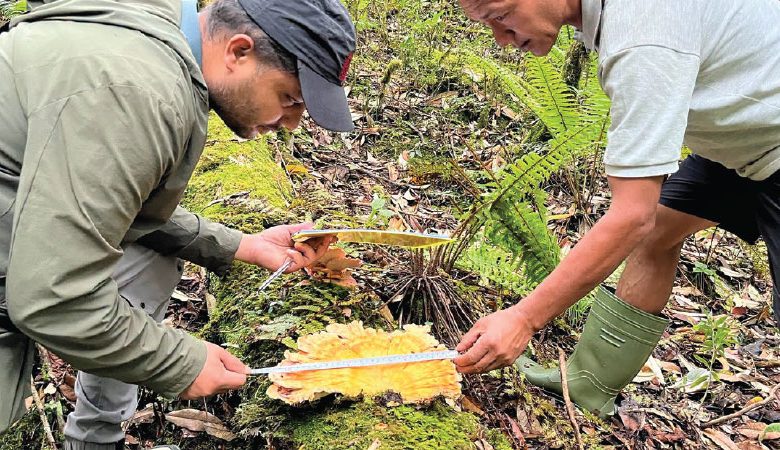
By Nabin Raj Kuinkel,Lamjung, July 9: The Annapurna Conservation Area Project (ACAP) has conducted a field survey of wild mushrooms found in the forests under its Bhujung Area Conservation Office in Lamjung.
According to Pramod Raj Regmi, chief of the Bhujung Area Conservation Office, the survey was carried out along three trekking routes including Siurung-Khilapu-Koprong-Thurju-Dudhpokhari, Thurju-Phurju-Dhom-Rorocho-Bhujung and Bhujung-Hragung-Pasgaon-Kamagaaun.
The study aimed to identify wild mushroom diversity, collect data and prepare scientific records.
Regmi said the week-long survey found mushrooms up to the Deurali area, just below Dudhpokhari, on the Lamjung-Manang border. Mushrooms were recorded at an altitude of about 4,300 metres above sea level. The area lies within the jurisdictions of Marsyangdi Rural Municipality and Kwholasothar Rural Municipality in Lamjung.
During the survey, researchers collected information on the distribution, habitat and biodiversity of mushrooms at every 500-metre elevation interval. Regmi said the data are being analysed and the exact identification of the mushroom species will be confirmed after the study is completed.
More than 50 species of wild mushrooms were recorded along the three survey routes. The office also conducted a questionnaire survey among local communities on the collection, identification, use and conservation of edible and poisonous mushrooms.
Locals shared their experiences, traditional knowledge and suggestions related to wild mushrooms. Regmi said the information gathered would support biodiversity conservation, the sustainable use of mushrooms and future research in the conservation area.
Basudev Neupane, Natural Resource Conservation Assistant at ACAP, said the preliminary survey found both edible and poisonous mushroom species. He said the participation of local resource persons helped establish a baseline record of mushroom species found within the conservation area.
According to Neupane, the study has also documented the number of edible and poisonous mushroom species in the Annapurna region, local methods of collecting and using mushrooms, their contribution to rural livelihoods and the traditional knowledge associated with them.
He said the findings will help prepare a scientific inventory of mushroom species in the conservation area, strengthen biodiversity research and provide a foundation for future conservation, sustainable use and research programmes.
Various studies show that Nepal is home to around 1,300 mushroom species, of which more than 100 are poisonous. Several species are also considered to have medicinal value.
The Rising Nepal